WOW! A near sell out. I was only expecting @5 people and now I've got
20+ people attending my Interaction 14 workshop. Good job I printed
enough sets of method cards for a full house, but I never thought I'd
need them all. I'm honoured.
From Twitter:
@ixdconf Only 5 tickets left for 'Circle of Visual Interpretation Workshop' by @VisualHermeneut http://interaction14.ixda.org/program/wednesday/286-circle-of-visual-interpretation-workshop #IxD14

Showing posts with label Visual Phenomenological Methodology. Show all posts
Showing posts with label Visual Phenomenological Methodology. Show all posts
Wednesday, 22 January 2014

Monday, 20 January 2014
Re-emerging from the PhD… my upcoming workshop at Interaction 14
After months of hard work of PhD projects, I'll be workshopping the first practical iteration of my research into a Visual Phenomenological Methodology in Amsterdam in February at Interaction 14.
In my workshop Circle of Visual Interpretation I'll be using packs of 11 method cards featuring 7 steps to visually interpret an experience…

Workshop using a visually interpretive method that reveals
to interaction designers what users experience in ways that personas
can’t communicate.
It is difficult to know for certain that the experience of one user will be the same as that for other users, and if other users sense the same things or encounter the world in the same way as each other. Yet interaction designers have to find a way of designing new interactions to suit their target audiences. Alan Cooper argues quite rightly that, “if you’re going to do user-centered design you’ve got to understand the user.”
This half-day workshop will give you, the interaction design professional, direct, hands–on experience of a new low cost methodology you can employ to reveal the meaning of user experiences through interpretation of the user’s experience itself. This emergent methodology will augment your personas within the normal ideation phase of your design process, creating a deeper understanding of what your users actually do, think, feel etc. rather that what they consciously think they know.
The practical workshop’s activities encourage the application of a method to reveal actual user experience through ‘the eyes of the users’ by applying a technique of hermeneutic-semiosis - which means visual interpretation through semiotics.
Themes in workshop include:
During this half-day workshop, we will use a very practical method card approach rather than a dry academic approach. The underlying hermeneutic-semiosis theory that (synthesising aspects of Pragmatism, and Martin Heidegger through C.S. Peirce’s semiotics) acts as a framework for the practical exploration.
You’ll come away with a clear understanding of the principles behind the methodology, and practical ideas that can inform your future interaction designs in new ways. It will also open up the debate as to how Visual Communication can be utilised more in the design of better interactive user experiences.
In the workshop you will:
In my workshop Circle of Visual Interpretation I'll be using packs of 11 method cards featuring 7 steps to visually interpret an experience…
Front and back of Step 4 card.
Places on the workshop are now available. Book a place via http://interaction14.ixda.org/program/wednesday/286-circle-of-visual-interpretation-workshop
More information will be posted on this blog in it's own designated Circle of Visual Interpretation Cards area.
More information will be posted on this blog in it's own designated Circle of Visual Interpretation Cards area.
Circle of Visual Interpretation Workshop
February 5th, Wednesday 09:30 HKU Hilversum, Amsterdam.
Morning workshop by Dave Wood
It is difficult to know for certain that the experience of one user will be the same as that for other users, and if other users sense the same things or encounter the world in the same way as each other. Yet interaction designers have to find a way of designing new interactions to suit their target audiences. Alan Cooper argues quite rightly that, “if you’re going to do user-centered design you’ve got to understand the user.”
This half-day workshop will give you, the interaction design professional, direct, hands–on experience of a new low cost methodology you can employ to reveal the meaning of user experiences through interpretation of the user’s experience itself. This emergent methodology will augment your personas within the normal ideation phase of your design process, creating a deeper understanding of what your users actually do, think, feel etc. rather that what they consciously think they know.
The practical workshop’s activities encourage the application of a method to reveal actual user experience through ‘the eyes of the users’ by applying a technique of hermeneutic-semiosis - which means visual interpretation through semiotics.
Themes in workshop include:
- The Essence of Experience;
- Hermeneutic-Semiosis;
- The Circle of Interpretation.
During this half-day workshop, we will use a very practical method card approach rather than a dry academic approach. The underlying hermeneutic-semiosis theory that (synthesising aspects of Pragmatism, and Martin Heidegger through C.S. Peirce’s semiotics) acts as a framework for the practical exploration.
You’ll come away with a clear understanding of the principles behind the methodology, and practical ideas that can inform your future interaction designs in new ways. It will also open up the debate as to how Visual Communication can be utilised more in the design of better interactive user experiences.
In the workshop you will:
- Discover how the methodology works through easy-to-use method cards;
- Participate in structured practical activities from the method cards to help show how you can apply it to your projects;
- Understand how to reveal more from your user research to achieve a fuller picture of your users, based on their actual points-of-view;
- Feedback your thoughts from the exercises and help further develop the methodology.
- Identifying themes of an experience—training participants to identify invariant themes in an experience from within user research;
- Revealing essence of experience—applying the principles of the method to reveal hidden user experience;
- Visually interpreting the experience—using a visual hermeneutic circle to refine the revealed experiential essence.
Thursday, 4 April 2013
Been quiet but not idle… UXPA Talk - "DYNAMIC SINSIGN" 21st May
Although the blog has been quiet I haven't. I've been busy with my students, proofing my new book and working hard on my PhD. Some of the results of that work will appear on this blog over the coming weeks and presented to the members of User Experience Professionals Association in Edinburgh on the 21st May.
The talk is called Dynamic sinsign: Sign-action communicating experiential themes. Check out the link here to book a place.
http://uxpa-scotland.org/events.php
The talk is free for UXPA members, £10 for non-members, and £5 for students. Pay at the door. [Payment is a UXPA thing - I'm speaking for no fee so I have nothing to do with the money!]
Venue
Skyscanner: Quartermile One, 15 Lauriston Pl, Edinburgh EH3 9EN. LATECOMERS CAN NOT BE ADMITTED
Information
DYNAMIC SINSIGN:SIGN-ACTION COMMUNICATING EXPERIENTIAL THEMES
About the event
This talk emerges out of Dave’s current research-in-progress into interaction design from a Visual Communication perspective. Through a clever synthesis of Peircean semiotics and Martin Heidegger, Dave will discuss how the user experience can be revealed in a new way that connects HCI and interaction design with Visual Communication. The 45 minute illustrated talk is for any UX designer who’d like to get into the mind of the user to see what they experience in a hermeneutically direct way that personas and mental models can’t communicate.
In the first section of Dave’s talk he’ll set out the context for how Visual Communication can inform user experience:
More about the speaker
Dave is author of Interface Design: An introduction to visual communication in UI design to be published by Bloomsbury (AVA) in October 2013. Originally an illustrator, in 1997 he made the transition into interaction design designing interfaces. In the last decade he has become more interested in the user experience and the re-positioning of the design discipline of Visual Communication over the design of future interactions. His interest now lies in understanding the user's experience in the interaction and exploring how this can be communicated to other designers.
He is a lecturer in digital design and design researcher at Glasgow Caledonian University, teaching on BA(Hons) Graphic Design for Digital Media. He teaches across all 4 years, and in the 3rd year he teaches a user experience module called Design and the User to design students.
A member of the Interaction Design Association, he has academically published his research and is currently in the practical phase of a practice-based Visual Communication PhD at Edinburgh College of Art. Check out his academic profile http://gcal.academia.edu/DaveWood/ and blog http://internalexternal-2010.blogspot.co.uk/.
The talk is called Dynamic sinsign: Sign-action communicating experiential themes. Check out the link here to book a place.
http://uxpa-scotland.org/events.php
The talk is free for UXPA members, £10 for non-members, and £5 for students. Pay at the door. [Payment is a UXPA thing - I'm speaking for no fee so I have nothing to do with the money!]
Venue
Skyscanner: Quartermile One, 15 Lauriston Pl, Edinburgh EH3 9EN. LATECOMERS CAN NOT BE ADMITTED
Information
DYNAMIC SINSIGN:SIGN-ACTION COMMUNICATING EXPERIENTIAL THEMES
About the event
This talk emerges out of Dave’s current research-in-progress into interaction design from a Visual Communication perspective. Through a clever synthesis of Peircean semiotics and Martin Heidegger, Dave will discuss how the user experience can be revealed in a new way that connects HCI and interaction design with Visual Communication. The 45 minute illustrated talk is for any UX designer who’d like to get into the mind of the user to see what they experience in a hermeneutically direct way that personas and mental models can’t communicate.
In the first section of Dave’s talk he’ll set out the context for how Visual Communication can inform user experience:
- Visual Communication as a facilitator in behavioural change
- Interpreting the Hidden
- Signified Inspirational Data
- Experience probes - capturing experiences
- Experiential themes and dynamic sinsigns - visual interpretation
- Visual Hermeneutic Circle - analysing and reduction
More about the speaker
Dave is author of Interface Design: An introduction to visual communication in UI design to be published by Bloomsbury (AVA) in October 2013. Originally an illustrator, in 1997 he made the transition into interaction design designing interfaces. In the last decade he has become more interested in the user experience and the re-positioning of the design discipline of Visual Communication over the design of future interactions. His interest now lies in understanding the user's experience in the interaction and exploring how this can be communicated to other designers.
He is a lecturer in digital design and design researcher at Glasgow Caledonian University, teaching on BA(Hons) Graphic Design for Digital Media. He teaches across all 4 years, and in the 3rd year he teaches a user experience module called Design and the User to design students.
A member of the Interaction Design Association, he has academically published his research and is currently in the practical phase of a practice-based Visual Communication PhD at Edinburgh College of Art. Check out his academic profile http://gcal.academia.edu/DaveWood/ and blog http://internalexternal-2010.blogspot.co.uk/.
Sunday, 12 August 2012
The Semiotics of Embodied Interaction… Semiotics and Phenomenology (and) Pragmatism
O’Neill,
S. (2008) Interactive Media: The
Semiotics of Embodied Interaction. London: Springer-Verlag.
“The cognitive theories from psychology, which tend to understand human beings as information processing units and phenomenological approaches, which turn towards the importance of the body and action without thought. An alternative strand of theory that is particularly relevant to our concerns with new media is that of semiotics, which tries to understand interaction from the perspective of signification and communication.” (p39)
Annotation
Here O’Neill begins to set out how semiotics is associated with a phenomenological (and even pragmatist) approach to understanding experience. Just as Ihde created a postphenomenology from a fusion of pragmatism and phenomenology, for me to create a visual communication phenomenological methodology the synthesising semiotic theory into understanding interactive experiences is crucial.
Wednesday, 1 August 2012
Toward a Phenomenological Understanding of Visual Communication… A Visual Communication Phenomenological Methodology
BARBATSIS, G. (2002) Toward a Phenomenological Understanding of Visual
Communication. Journal of Visual Literacy,
22(1),
pp1-18
Annotation
How a phenomenological understanding of meaning-making in a dyadic relationship between human and computer can be revealed by visual communication, calls for a methodology. I am proposing such a methodology in the form of a Visual Communication Phenomenological Methodology.
“The dialogue, which
takes place between makers and beholders absent to each other, is an
achievement of encoding and decoding. Phenomenological understandings of visual
communication illuminate, in the terms of dialogue, how this meaning-making
work in the separate domains of production and reception is done.” (p7)
Annotation
How a phenomenological understanding of meaning-making in a dyadic relationship between human and computer can be revealed by visual communication, calls for a methodology. I am proposing such a methodology in the form of a Visual Communication Phenomenological Methodology.
Wednesday, 21 September 2011
Obey the Visual - Synthesising a Visual Phenomenology?
This post is a draft for a new academic paper aimed at a graphic design journal. It continues on from the previous post, and represents writing-in-progress. Feel free to comment but questions on how or what next will be answered in future posts as I construct my paper.
I will be making a case for the development of a Visual Phenomenological Methodology within Visual Communication later in this paper. But before I do I wish to explore phenomenology’s existing connections. Phenomenology as a philosophical and a qualitative research methodology have yet to truly be adapted within a Visual Communication context. Design journalist Rick Poynor points out that the discipline “has long had an aversion to theory” (Poynor, 2003, p10).
This is no wonder because as young discipline Visual Communication does not have “a couple of centuries’ worth” of academic design literature (Rock and Poynor, 1995) that other disciplines may have. From the existing literature it does have the word phenomena is widely used (Heller & Ballance, 2001; Margolin & Buchanan, 1996; Williams & Newton, 2007; Huck et al, 1997; Hill & Helmers, 2004; Barry, 1997) to describe the internal and external characteristics of graphic outcomes or in pictorial representation. Kenney in his essay on Representation Theory in The Handbook of Visual Communication (2005, p112) discusses image representation through lenses of semiotics, rhetoric and phenomenology, concluding that a theoretical synthesis would be a useful model for understanding image representations.
In Kenney’s later book on Visual Communication Research Designs (2009) it features examples of qualitative research methodologies available to visual communicators such as ethnography, discourse analysis and content analysis. But still nothing on synthesising phenomenology into a useful methodology despite the liberal use of the term ‘phenomena’. At this point a brief review of phenomenology within a Visual Communication context would be beneficial. To begin this I will discuss Shepard Fairey’s “Obey The Giant” sticker campaign called by himself as an “experiment in Phenomenology” (Fairey, 1990).
The Obey The Giant sticker campaign began in 1989 and is still an active piece of Visual Communication as a meme and subversive street art. Using a reductively stylised stencil cut illustration of the deceased wrestler Andre the Giant (see fig. 1) stickers, posters and sprayed images have spread across cities in North America into the western world. The image of Andre’s face hypnotically stares straight out and solely features the command “obey”. Obey The Giant was originally an undergraduate illustration project initiated by Shepard Fairey. In 1990 he wrote a manifesto behind the sticker campaign in which he “attempts to stimulate curiosity and bring people to question both the sticker and their relationship with their surroundings” (Fairey, 1990).

(Fig. 1 - Shepard Fairey and Obey The Giant (poster variant). Photo: Elizabeth Daniels)
The underlying tension of the campaign is the ambiguous nature of the relationship between image and text and it’s interpretation. Without Fairey’s context the sticker has been both embraced and rejected by people in the environments it is seen. A cultivated sense of a cultish communication is intrinsically linked to the phenomenon. In a later interview (undated, but at least post-1997) Fairey admits that Obey was “about creating an individual dialogue process that can expand into people trying to interpret it, and asking someone else, and then there’s two people talking about it. Something just going on that people can’t pigeonhole along with everything else” (Goodfellow, N.D.).
When journalists and commentators discuss Fairey’s Obey campaign they usually lead with the first line of his manifesto “The OBEY sticker campaign can be explained as an experiment in Phenomenology” (Fairey, 1990). Fairey briefly contextualises this statement with a brief explanation of phenomenology from a Heideggerian perspective. But this framing of the Obey campaign as a phenomenological experiment is very weak. He himself admits in interview with Goodfellow that he wrote it to satisfy college-educated people who “want you to empirically break down what it is, what it’s doing, and why. So I wrote the explanation for those intellectual Doubting Thomases, who’ve got to stick their finger in the hole” (Goodfellow, N.D.).
Fairey’s manifesto (Fairey, 1990) makes a clear statement that Obey is meant to stimulate curiosity and questioning of both the image itself and the image in the context of its surroundings. To achieve this he claims that the “first aim of phenomenology is to reawaken a sense of wonder about one’s environment”. Citing Heidegger, Fairey’s definition of phenomenology is weakly understood, “Phenomenology attempts to enable people to see clearly something that is right before their eyes but obscured; things that are so taken for granted that they are muted by abstract observation” (ibid.). As an example of Visual Communication it is a very strong project as an exercise in creating debate over meaning and interpretation. But as an example of Visual Communication using phenomenological theory and practice, it is a misnomer.
(To be cont.)
References
BARRY, A.M. (1997) Visual Intelligence: Perception, Image and Manipulation in Visual Communication. New York: State University of New York Press.
FAIREY, S. (1990) Manifesto – Obey Giant [online]. [Accessed 20 September 2011]. Available from: http://obeygiant.com/about
GOODFELLOW, C. (N.D) Andre The Giant Is Watching You [online]. [Accessed 27 September 2011]. Available from: http://obeygiant.com/articles/andre-the-giant-is-watching-you
HELLER, S. and BALLANCE, G. (2001) Graphic Design History. Allworth Communications.
HILL, C.A. and HELMERS, M.H. (2004) Defining Visual Rhetorics. Routledge.
HUCK, F.O., FALES, C.L. and RAHMAN, Z. (1997) Visual Communication: An Information Theory Approach. Springer.
KENNEY, K. (2005) Representation Theory. In K.S. SMITH, S. MORIARTY, K. KENNEY, and G. BARBATSIS (eds) Handbook of Visual Communication: Theory, Methods, and Media. Routledge. pp99-115
KENNEY, K. (2009). Visual Communication Research Designs. New York: Routledge.
MARGOLIN, V. and BUCHANAN, R. (1996) The Idea of Design. MIT Press.
POYNOR, R. ed. (2003) No More Rules: Graphic Design and Postmodernism. London: Laurence King Publishing Ltd.
ROCK, M. and POYNOR, R. (1995) What Is This Thing Called Graphic Design Criticism? Eye. 4 (16) pp56-59
WILLIAMS, R and NEWTON, J.H. (2007) Visual Communication: Integrating Media, Art and Science. Routledge.
Images:
DANIELS, E. (N.D.) Shepard Fairey [online]. [Accessed 27 September 2011]. Available from:http://www.elizabethdanielsphotography.com/#/89542/898486
I will be making a case for the development of a Visual Phenomenological Methodology within Visual Communication later in this paper. But before I do I wish to explore phenomenology’s existing connections. Phenomenology as a philosophical and a qualitative research methodology have yet to truly be adapted within a Visual Communication context. Design journalist Rick Poynor points out that the discipline “has long had an aversion to theory” (Poynor, 2003, p10).
This is no wonder because as young discipline Visual Communication does not have “a couple of centuries’ worth” of academic design literature (Rock and Poynor, 1995) that other disciplines may have. From the existing literature it does have the word phenomena is widely used (Heller & Ballance, 2001; Margolin & Buchanan, 1996; Williams & Newton, 2007; Huck et al, 1997; Hill & Helmers, 2004; Barry, 1997) to describe the internal and external characteristics of graphic outcomes or in pictorial representation. Kenney in his essay on Representation Theory in The Handbook of Visual Communication (2005, p112) discusses image representation through lenses of semiotics, rhetoric and phenomenology, concluding that a theoretical synthesis would be a useful model for understanding image representations.
In Kenney’s later book on Visual Communication Research Designs (2009) it features examples of qualitative research methodologies available to visual communicators such as ethnography, discourse analysis and content analysis. But still nothing on synthesising phenomenology into a useful methodology despite the liberal use of the term ‘phenomena’. At this point a brief review of phenomenology within a Visual Communication context would be beneficial. To begin this I will discuss Shepard Fairey’s “Obey The Giant” sticker campaign called by himself as an “experiment in Phenomenology” (Fairey, 1990).
The Obey The Giant sticker campaign began in 1989 and is still an active piece of Visual Communication as a meme and subversive street art. Using a reductively stylised stencil cut illustration of the deceased wrestler Andre the Giant (see fig. 1) stickers, posters and sprayed images have spread across cities in North America into the western world. The image of Andre’s face hypnotically stares straight out and solely features the command “obey”. Obey The Giant was originally an undergraduate illustration project initiated by Shepard Fairey. In 1990 he wrote a manifesto behind the sticker campaign in which he “attempts to stimulate curiosity and bring people to question both the sticker and their relationship with their surroundings” (Fairey, 1990).
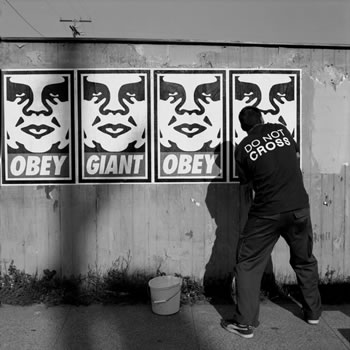
(Fig. 1 - Shepard Fairey and Obey The Giant (poster variant). Photo: Elizabeth Daniels)
The underlying tension of the campaign is the ambiguous nature of the relationship between image and text and it’s interpretation. Without Fairey’s context the sticker has been both embraced and rejected by people in the environments it is seen. A cultivated sense of a cultish communication is intrinsically linked to the phenomenon. In a later interview (undated, but at least post-1997) Fairey admits that Obey was “about creating an individual dialogue process that can expand into people trying to interpret it, and asking someone else, and then there’s two people talking about it. Something just going on that people can’t pigeonhole along with everything else” (Goodfellow, N.D.).
When journalists and commentators discuss Fairey’s Obey campaign they usually lead with the first line of his manifesto “The OBEY sticker campaign can be explained as an experiment in Phenomenology” (Fairey, 1990). Fairey briefly contextualises this statement with a brief explanation of phenomenology from a Heideggerian perspective. But this framing of the Obey campaign as a phenomenological experiment is very weak. He himself admits in interview with Goodfellow that he wrote it to satisfy college-educated people who “want you to empirically break down what it is, what it’s doing, and why. So I wrote the explanation for those intellectual Doubting Thomases, who’ve got to stick their finger in the hole” (Goodfellow, N.D.).
Fairey’s manifesto (Fairey, 1990) makes a clear statement that Obey is meant to stimulate curiosity and questioning of both the image itself and the image in the context of its surroundings. To achieve this he claims that the “first aim of phenomenology is to reawaken a sense of wonder about one’s environment”. Citing Heidegger, Fairey’s definition of phenomenology is weakly understood, “Phenomenology attempts to enable people to see clearly something that is right before their eyes but obscured; things that are so taken for granted that they are muted by abstract observation” (ibid.). As an example of Visual Communication it is a very strong project as an exercise in creating debate over meaning and interpretation. But as an example of Visual Communication using phenomenological theory and practice, it is a misnomer.
(To be cont.)
References
BARRY, A.M. (1997) Visual Intelligence: Perception, Image and Manipulation in Visual Communication. New York: State University of New York Press.
FAIREY, S. (1990) Manifesto – Obey Giant [online]. [Accessed 20 September 2011]. Available from: http://obeygiant.com/about
GOODFELLOW, C. (N.D) Andre The Giant Is Watching You [online]. [Accessed 27 September 2011]. Available from: http://obeygiant.com/articles/andre-the-giant-is-watching-you
HELLER, S. and BALLANCE, G. (2001) Graphic Design History. Allworth Communications.
HILL, C.A. and HELMERS, M.H. (2004) Defining Visual Rhetorics. Routledge.
HUCK, F.O., FALES, C.L. and RAHMAN, Z. (1997) Visual Communication: An Information Theory Approach. Springer.
KENNEY, K. (2005) Representation Theory. In K.S. SMITH, S. MORIARTY, K. KENNEY, and G. BARBATSIS (eds) Handbook of Visual Communication: Theory, Methods, and Media. Routledge. pp99-115
KENNEY, K. (2009). Visual Communication Research Designs. New York: Routledge.
MARGOLIN, V. and BUCHANAN, R. (1996) The Idea of Design. MIT Press.
POYNOR, R. ed. (2003) No More Rules: Graphic Design and Postmodernism. London: Laurence King Publishing Ltd.
ROCK, M. and POYNOR, R. (1995) What Is This Thing Called Graphic Design Criticism? Eye. 4 (16) pp56-59
WILLIAMS, R and NEWTON, J.H. (2007) Visual Communication: Integrating Media, Art and Science. Routledge.
Images:
DANIELS, E. (N.D.) Shepard Fairey [online]. [Accessed 27 September 2011]. Available from:http://www.elizabethdanielsphotography.com/#/89542/898486
Subscribe to:
Posts (Atom)