HIRSCH,
E.D. (1976) The Aims of Interpretation. Chicago: The University of Chicago
Press.
“If one had, then, to choose a hermeneutical
model it should hardly be one that entirely excluded the possibility of
Husserl’s brackets. The brackets implied by the terms ‘meaning’ and
‘significance’ do in fact represent something that most of us believe we
experience in verbal discourse, namely, an alien meaning, something meant by an
implied author or speaker who is not ourselves. Whenever we have posited
another person’s meaning, we have bracketed a region of our own experience as
being that of another person. The paradox of self and other in verbal discourse
is even easier to accept (because more widely experienced) than the paradox of
part and whole in the hermeneutic circle. No doubt the paradoxical doubling of
personality involved in the verbal intercourse is a bracketing experience for
which some persons have greater talents than others, but it is nonetheless a
widespread experience. The hermeneutic circle, on the other hand, as I shall
point out at the end of the next chapter, has now been shown to be an
inadequate model for what actually happens in the interpretation of speech. The
magic circle is breakable.” (p6)
Annotation:
Hirsch
believes that, in the context of interpretation of speech-based discourse at least, the hermeneutic circle breaks
down. The premise is that within an individual’s interpretation there is a part of someone else’s
thoughts. In Bohman’s holism this is a given part in the hermeneutic circle, but
Hirsh sees this as a paradox where there exists at the same time an interpretation that is both a
part and a whole. The notion of Husserl’s ‘bracketing of self’ to set aside any
influences that are ‘other’ to the current experience of interpretation is one that
Hirsh advocates if a hermeneutical
model is to be chosen to understanding
the act of interpretation.
Heidegger prefers to present the concept of pre-understanding to correspond to, and challenge
Husserl’s bracketing of an experience.

Showing posts with label bracketing. Show all posts
Showing posts with label bracketing. Show all posts
Thursday, 2 August 2012

Monday, 9 August 2010
Probing Experience
Mattelmäki in her book based on her Doctorate "Design Probes" features this diagram on the process for the application of probes. The caption reads:
"Fig. 53. The upper process stages describe the application of probes like empathy probes. The desire to create an understanding of the phenomena in an interactive process is emphasised. The lower process stages describe the way in which the probes are applied like cultural probes as sources of inspiration"
 The Application of Probes
Source: (Mattelmäki, 2006, p99)
The application begins with "Tuning In" (bracketing in phenomenological methodology), then "Probing", followed by two forms of "Interpretation", one deeper (top) than the other (bottom).
 My rough adaptation of Mattelmäki's diagram showing how my use of the probe differs from hers.
I am interested in using the probe to prepare each volunteer's perception - to help them attune themselves into understanding their own ability to appreciate experience from identifying a beginning until a consummation, without undue influence. Using the probe tasks they will in Task 1 attune themselves in their own way, with varying degrees of success or correlation to each other. In Task 2 which will be post-observation they will self-reflect and evaluate themselves, using their own method (mediated through the provided material in Task 2) to evaluate their experience. This method will be un-scientific, and Mattelmäki suggests that a more appropriate description would be "making sense, outlining or interpretation" (p88).
I will give the Probes out to those who volunteer at a briefing (1). Each volunteer will then do Task 1 before coming to a pre-observation contextual interview (2). At this audio recorded interview (3) I will get a sense of who this person is, how they are preparing themselves to be observed, and to bracket and document any prejudgments they may have of the observation. They will then be observed using the interactive installation (videoed and photographed for reference) (4). Post-observation, the volunteer will be directed to do Task 2 before the next interview. This post-observation contextual interview (5) will be a de-brief, and the task result will be used to begin the recorded interview. This fragmented qualitative data will then lead to (6). (6) is the development of a Visual Communication phenomenological framework.
The development of my Probe will be detailed in a separate post(s). Here are some examples of different Probes from Mattelmäki's book.
 Source: (Mattelmäki, 2006, p79)
 Source: (Mattelmäki, 2006, p83)
References used:
MATTELMÄKI, T. (2006). Design Probes. Unpublished doctoral dissertation, University of Art and Design Helsinki. Helsinki, Finland.
"Fig. 53. The upper process stages describe the application of probes like empathy probes. The desire to create an understanding of the phenomena in an interactive process is emphasised. The lower process stages describe the way in which the probes are applied like cultural probes as sources of inspiration"
 The Application of Probes
Source: (Mattelmäki, 2006, p99)
The application begins with "Tuning In" (bracketing in phenomenological methodology), then "Probing", followed by two forms of "Interpretation", one deeper (top) than the other (bottom).
 My rough adaptation of Mattelmäki's diagram showing how my use of the probe differs from hers.
I am interested in using the probe to prepare each volunteer's perception - to help them attune themselves into understanding their own ability to appreciate experience from identifying a beginning until a consummation, without undue influence. Using the probe tasks they will in Task 1 attune themselves in their own way, with varying degrees of success or correlation to each other. In Task 2 which will be post-observation they will self-reflect and evaluate themselves, using their own method (mediated through the provided material in Task 2) to evaluate their experience. This method will be un-scientific, and Mattelmäki suggests that a more appropriate description would be "making sense, outlining or interpretation" (p88).
I will give the Probes out to those who volunteer at a briefing (1). Each volunteer will then do Task 1 before coming to a pre-observation contextual interview (2). At this audio recorded interview (3) I will get a sense of who this person is, how they are preparing themselves to be observed, and to bracket and document any prejudgments they may have of the observation. They will then be observed using the interactive installation (videoed and photographed for reference) (4). Post-observation, the volunteer will be directed to do Task 2 before the next interview. This post-observation contextual interview (5) will be a de-brief, and the task result will be used to begin the recorded interview. This fragmented qualitative data will then lead to (6). (6) is the development of a Visual Communication phenomenological framework.
The development of my Probe will be detailed in a separate post(s). Here are some examples of different Probes from Mattelmäki's book.
 Source: (Mattelmäki, 2006, p79)
 Source: (Mattelmäki, 2006, p83)
References used:
MATTELMÄKI, T. (2006). Design Probes. Unpublished doctoral dissertation, University of Art and Design Helsinki. Helsinki, Finland.
Thursday, 5 August 2010
CODENAME: "Experience Pack" Shhhh!
Continuing from the previous post on Cultural Probes, this post will look more at how the concept of "Cultural Probe" has grown, morphed and expanded into specific qualitative tools. These other tools go by names such as Informational Probe, Mobile Probes, Technology Probes, Empathy Probes (Bernhaupt et al., 2007), and are designed to elicit different data from different situations. It is on the back of this appropriation of Gaver's original concept that I wish to design a specific tool to help me prepare and elicit volunteer's awareness of experiencing an experience.
 Source: (Kjeldskov et al., 2004)
 Source: (Dalsgaard et al., 2006)
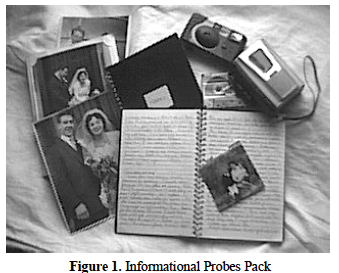 Source: (Crabtree et al., 2002)
Finnish academic Tuuli Mattelmäki (2006, p58) says that there are four powerful reasons for applying probes: INSPIRATION; INFORMATION; PARTICIPATION; and DIALOGUE.
 Source: (Mattelmäki, 2006)
All four of these reasons fit into my rationale for designing a probe for the initial recruitment phase of my research project. To be able to bracket my understanding of the phenomenon of aesthetics of use I have to be very careful how I prepare volunteers from the briefings. I cannot guide them in the use of an interactive installation, but I don't just want the volunteer to flounder in the face of unfamiliar technology.
 Source: (Mattelmäki, 2006)
 Source: (Mattelmäki, 2006)
 Source: (Mattelmäki, 2006)
 Source: (Mattelmäki, 2006)
I want to prepare them enough to understand it, but it is THEIR experience of the technology I am interested in. To ensure they appreciate what I am there for is not the same as them, I need to enter into a controlled (phenomenonologically bracketed) DIALOGUE with them so they have an awareness about 'experience'. Through the first part of MY PROBE they will be INSPIRED to PARTICIPATE through some reflective INFORMATION from them. My thoughts are for this stage is to use the postcard component of a Cultural Probe.

Source: (Júdice & Júdice, 2007)
This "Experience Pack" Probe Kit will be designed by myself and will be given out only to those who commit to volunteering at the briefings as homework before I meet them again for the first pre-observation contextual interview. The first task (more on this in a future post) will begin their awareness of what I am examining without me being didactic. At the contextual interview their responses can then be the focus of the discussion, through which I can prepare them for observation without influencing their potential actions on the day.
I will have a second post-observation task in the Probe they can do as an evaluatory and reflective exercise soon after their fun with the interactive installation. The results of this task will then be brought to the post-observation contextual interview. This means the design of only two components. As the abilities with technology are mixed within the potential volunteers I will include in the pack very concise directions for use, and maybe also a CD with oral directions too. This pack will be aesthetic too to facilitate engagement, and a souvenir of their time spent. Maybe also a certificate of involvement will be appealing to them? The Probe will fit in a tin meant to fit a plastic DVD box, and I'm thinking of applying a vinyl logo to the front of the case. This logo will be a numbered limited edition to add to the exclusiveness of those who volunteer out of those attending the briefing.
There are four stages to the Aesthetic Volunteers involvement: BRIEFING; INTERVIEW 1; OBSERVATION; and INTERVIEW 2. There are four reasons to apply a Probe (see above). The number FOUR seems to be a recurring number, so I will limit the Probe's contents to be FOUR items: TASK 1 (4 questions on 4 postcards); TASK 2 (TBA); 1 CD; and 1 CERTIFICATE.
But my "Experience Pack" isn't really a Cultural Probe as I'm more interested in finding out about experience from a phenomenological perspective. Does this make my pack a "Phenomena Probe"? Is it an "Empathy Probe"? Or is it a "Socio-cultural Probe"? I think I need to read Mattelmäki's PhD Dissertation to answer that.
References used:
BERNHAUPT, R., WEISS, A., OBRIST, M., and TSCHELIGI, M. (2007) Playful Probing: Making Probing More Fun. In Proceedings of the 11th IFIP TC 13 international Conference on Human-Computer interaction (Rio de Janeiro, Brazil). C. Baranauskas, P. Palanque, J. Abascal, and S. D. Barbosa, Eds. Lecture Notes In Computer Science. Springer-Verlag, Berlin, Heidelberg, 606-619.
CRABTREE, A., HEMMINGS, T., RODDEN, T., CHEVERST, K., CLARKE, K., DEWSBURY, G. AND ROUNCEFIELD, M. (2002) Probing for Information. In the proceedings of the 2nd EQUATOR Conference. November 2002. Brockenhurst. [Accessed 4 August 2010]. Available from World Wide Web: http://bscw.cs.ncl.ac.uk/pub/nj_bscw.cgi/S4ace2ee7/d50013/Crabtree,%20Hemmings,%20Rodden,%20Cheverst,%20Clarke,%20Dewsbury%20and%20Rouncefield-Probing%20for%20Information..pdf
DALSGAARD, T., SKOV, M.B., STOUGAARD, M. and THOMASSEN, B. (2006) Mediated Intimacy In Families: Understanding The Relation Between Children and Parents. In the proceedings of the 2006 Conference on Interaction Design and Children, June 07-09, 2006, Tampere, Finland. [Accessed 5 August 2010]. Available from World Wide Web: http://portal.acm.org/citation.cfm?id=1139110
JÚDICE, A. and JÚDICE, M. (2007) Designing Cultural Probes to Study “Invisible” Communities in Brazil. In the proceedings of Design Inquiries: The second Nordic Design Research Conference. Stockholm 27-30 May, Stockholm. [Accessed 5 August 2010]. Available from World Wide Web: http://www.nordes.org/data/uploads/papers/140.pdf
KJELDSKOV, J., GIBBS, M. R., VETERE, F., HOWARD, S., PEDELL, S., MECOLES, K. and BUNYAN, M. (2004) Using Cultural Probes to Explore Mediated Intimacy. In the proceedings of OzCHI, University of Wollongong, [Accessed 4 August 2010]. Available from World Wide Web: http://dl.acs.org.au/index.php/ajis/article/viewFile/128/107
MATTELMÄKI, T. (2006). Design Probes. Unpublished doctoral dissertation, University of Art and Design Helsinki. Helsinki, Finland.
 Source: (Kjeldskov et al., 2004)
 Source: (Dalsgaard et al., 2006)
 Source: (Crabtree et al., 2002)
Finnish academic Tuuli Mattelmäki (2006, p58) says that there are four powerful reasons for applying probes: INSPIRATION; INFORMATION; PARTICIPATION; and DIALOGUE.
 Source: (Mattelmäki, 2006)
All four of these reasons fit into my rationale for designing a probe for the initial recruitment phase of my research project. To be able to bracket my understanding of the phenomenon of aesthetics of use I have to be very careful how I prepare volunteers from the briefings. I cannot guide them in the use of an interactive installation, but I don't just want the volunteer to flounder in the face of unfamiliar technology.
 Source: (Mattelmäki, 2006)
 Source: (Mattelmäki, 2006)
 Source: (Mattelmäki, 2006)
 Source: (Mattelmäki, 2006)
I want to prepare them enough to understand it, but it is THEIR experience of the technology I am interested in. To ensure they appreciate what I am there for is not the same as them, I need to enter into a controlled (phenomenonologically bracketed) DIALOGUE with them so they have an awareness about 'experience'. Through the first part of MY PROBE they will be INSPIRED to PARTICIPATE through some reflective INFORMATION from them. My thoughts are for this stage is to use the postcard component of a Cultural Probe.

Source: (Júdice & Júdice, 2007)
This "Experience Pack" Probe Kit will be designed by myself and will be given out only to those who commit to volunteering at the briefings as homework before I meet them again for the first pre-observation contextual interview. The first task (more on this in a future post) will begin their awareness of what I am examining without me being didactic. At the contextual interview their responses can then be the focus of the discussion, through which I can prepare them for observation without influencing their potential actions on the day.
I will have a second post-observation task in the Probe they can do as an evaluatory and reflective exercise soon after their fun with the interactive installation. The results of this task will then be brought to the post-observation contextual interview. This means the design of only two components. As the abilities with technology are mixed within the potential volunteers I will include in the pack very concise directions for use, and maybe also a CD with oral directions too. This pack will be aesthetic too to facilitate engagement, and a souvenir of their time spent. Maybe also a certificate of involvement will be appealing to them? The Probe will fit in a tin meant to fit a plastic DVD box, and I'm thinking of applying a vinyl logo to the front of the case. This logo will be a numbered limited edition to add to the exclusiveness of those who volunteer out of those attending the briefing.

There are four stages to the Aesthetic Volunteers involvement: BRIEFING; INTERVIEW 1; OBSERVATION; and INTERVIEW 2. There are four reasons to apply a Probe (see above). The number FOUR seems to be a recurring number, so I will limit the Probe's contents to be FOUR items: TASK 1 (4 questions on 4 postcards); TASK 2 (TBA); 1 CD; and 1 CERTIFICATE.
But my "Experience Pack" isn't really a Cultural Probe as I'm more interested in finding out about experience from a phenomenological perspective. Does this make my pack a "Phenomena Probe"? Is it an "Empathy Probe"? Or is it a "Socio-cultural Probe"? I think I need to read Mattelmäki's PhD Dissertation to answer that.
References used:
BERNHAUPT, R., WEISS, A., OBRIST, M., and TSCHELIGI, M. (2007) Playful Probing: Making Probing More Fun. In Proceedings of the 11th IFIP TC 13 international Conference on Human-Computer interaction (Rio de Janeiro, Brazil). C. Baranauskas, P. Palanque, J. Abascal, and S. D. Barbosa, Eds. Lecture Notes In Computer Science. Springer-Verlag, Berlin, Heidelberg, 606-619.
CRABTREE, A., HEMMINGS, T., RODDEN, T., CHEVERST, K., CLARKE, K., DEWSBURY, G. AND ROUNCEFIELD, M. (2002) Probing for Information. In the proceedings of the 2nd EQUATOR Conference. November 2002. Brockenhurst. [Accessed 4 August 2010]. Available from World Wide Web: http://bscw.cs.ncl.ac.uk/pub/nj_bscw.cgi/S4ace2ee7/d50013/Crabtree,%20Hemmings,%20Rodden,%20Cheverst,%20Clarke,%20Dewsbury%20and%20Rouncefield-Probing%20for%20Information..pdf
DALSGAARD, T., SKOV, M.B., STOUGAARD, M. and THOMASSEN, B. (2006) Mediated Intimacy In Families: Understanding The Relation Between Children and Parents. In the proceedings of the 2006 Conference on Interaction Design and Children, June 07-09, 2006, Tampere, Finland. [Accessed 5 August 2010]. Available from World Wide Web: http://portal.acm.org/citation.cfm?id=1139110
JÚDICE, A. and JÚDICE, M. (2007) Designing Cultural Probes to Study “Invisible” Communities in Brazil. In the proceedings of Design Inquiries: The second Nordic Design Research Conference. Stockholm 27-30 May, Stockholm. [Accessed 5 August 2010]. Available from World Wide Web: http://www.nordes.org/data/uploads/papers/140.pdf
KJELDSKOV, J., GIBBS, M. R., VETERE, F., HOWARD, S., PEDELL, S., MECOLES, K. and BUNYAN, M. (2004) Using Cultural Probes to Explore Mediated Intimacy. In the proceedings of OzCHI, University of Wollongong, [Accessed 4 August 2010]. Available from World Wide Web: http://dl.acs.org.au/index.php/ajis/article/viewFile/128/107
MATTELMÄKI, T. (2006). Design Probes. Unpublished doctoral dissertation, University of Art and Design Helsinki. Helsinki, Finland.
Subscribe to:
Posts (Atom)