Amongst other things, over the last seven days I have been finalising the proposal for my project. I am quite excited by it, as it is a new framework. Here is my abstract that gives its gist…
"This particular research aims to establish the creation of a Visual Communication Phenomenological Methodology to explore the aesthetics of use from a Visual Communication perspective. This framework develops the desire for this discipline’s repositioning as an influence on Interaction Design, a sister design discipline. It also offers a qualitative methodology to support Human-Computer Interaction (HCI) researchers to legitimise their work within the 3rd HCI paradigm using a Phenomenological Matrix. In this proposal I introduce this area of research, and set parameters of my research rationale. The research project will last four months, and will be the basis of my MPhil transfer document to continue onto the PhD. I identify a hole within the literature that my proposal will answer. I then go on to to explain the methods I will use, and the results I expect. Finally I discuss the potential impact of my proposed research, plus its limitations and initial weaknesses. This is in order to convince the reader that this research is both relevant, and it contributes new knowledge to an established area of research into the Aesthetics of Interaction."

Monday, 30 August 2010

Monday, 23 August 2010
FLOW
I've finally just got around to reading FLOW: The Psychology of Optimal Experience by Mihaly Csikszentmihalyi (pronounced cheek-sent-me-high (thanks Mary)).
It looks like I'll have to read it fast as it features very relevant points of connection to my research. More on this I'm sure in a later post.
Thursday, 19 August 2010
Writing my research proposal
I'm juggling different bits of my project this week. So far since Saturday I have been:
- sourcing materials for the "experience probe"
- sourcing printers
- art directing the individual aspects of the probes
- maintaining the annotated bibliography (now about 112 sources)
- reading and planning the Phenomenological research methodology
- writing up the research proposal
- organising the recruitment of research volunteers
- arranging a meeting with the gatekeeper of the facility and interactive installation
- going to four Edinburgh FRINGE shows (I've got to relax too)
- Oh, and working full time as a lecturer
Saturday, 14 August 2010
Progressive Visual Communication
Pending - will discuss soon
"Visual communication design can be, as noted at the beginning, both an activity of conceiving, planning, projecting, and producing visual communications, normally implemented through industrial means, and orientated at broadcasting specific messages to specific publics. This is done to obtain a reaction, connected to the knowledge, the attitudes, the feelings, or the behavior of the public. A design is an object created by that activity." (Frascara, 2004, p189)
"Interaction is our human way of dealing with things and with information. Interaction is central to communication. We must forget the old ideas of “transmitter” and “receiver”: Real people do not receive information. For stimuli to become information, one has to actively interpret, through a variety of actions, whatever one is confronting. To live is to interact. The computer world does not own the function." (Frascara, 2004, p173)
"Given the visual nature of our culture in general, and the increasing volume of visual information in particular, visual communication designers can make substantial contributions to the clarity, effectiveness, beauty, and economic viability of the ever-growing flow of information. They can facilitate this flow and contribute to the quality of our society and our life." (Frascara, 2004, p190)
"graphic design in fact produces and reproduces society and culture." (Barnard, 2005, p59)
"And James W. Carey (1992) argues that ‘to study communication is to examine the actual social process wherein significant symbolic forms are created, apprehended and used’. Effectively, he is arguing that the study of communication is the study of culture, and that the study of communication is the study of culture, and that culture is the creation and use of meaningful forms, which would clearly include graphic design." (Barnard, 2005, p67)
"So, graphic design may be thought of as a signifying system, within a much larger system, which includes and accounts for all of the other ways in which a society constructs and communicates meaning (fashion, literature, music, language, art, philosophy and so on)." (Barnard, 2005, p67)
"Clearly, this book is committed to the idea that there can be no such thing as non-cultural communication; it has argued that all communication is predicated on the existence of signs and codes which, as profoundly cultural, must be learned in order for communication to be possible." (Barnard, 2005, p129)
References used:
BARNARD, M. (2005) Graphic Design as Communication. Abingdon: Routledge.
FRASCARA, J. (2004) Communication Design: Principles, Methods and Practice. New York: Allworth Press.
TOGNAZZINI, B. (2003) It's Time We Got Respect [online]. [Accessed 2nd January 2009]. Available from: http://www.asktog.com/columns/057ItsTimeWeGotRespect.html
BARNARD, M. (2005) Graphic Design as Communication. Abingdon: Routledge.
FRASCARA, J. (2004) Communication Design: Principles, Methods and Practice. New York: Allworth Press.
TOGNAZZINI, B. (2003) It's Time We Got Respect [online]. [Accessed 2nd January 2009]. Available from: http://www.asktog.com/columns/057ItsTimeWeGotRespect.html
Organisation of the Perceptual, Emotional and Cognitive Processes
Frascara, in discussing Visual Communication's focus on selecting the visual elements of text and image communicate it's "Sinn"* says,
The Interaction Design heavy weight Bruce Tognazzini (he founded the Apple Human Interface Group and acted as Apple's Human Interface Evangelist) wrote back in 2003 in an AskTog article "It's Time We Got Respect" that,
If communication, meaning, interpretation and construction can only be understood through qualitative means then, I argue that a methodology of understanding this through adaptation of research methods taken from Phenomenology would help reposition Visual Communication's status. As sections of the HCI research community are also looking to a Phenomenological paradigm over the last decade to understand experience, especially aesthetic experience, this strengthens my research perspective.
"Every shape evokes a response - more or less cognitive, more or less emotional. This demonstrates the importance of designers in the organization of the perceptual, emotional, and cognitive processes to be followed by the viewer, beyond purely aesthetic issues. It would be a fundamental error to believe that in design one can deal with the form independent of content, or with sensorial, independent of the cognitive and the emotional." (2004, p65)Barnard folds into this the semiological roots of Visual Communication,
"Signs and codes are the bases of meanings in semiology. And signs and codes are explained in terms of learned and variable cultural rules. For semiology, then, communication is a cultural phenomenon, not an engineering problem, as it is in communication theory.” (2005, p28)"Semiologically the Mise en Scene of a design's elements are produced and organised by the designer to facilitate the reception by the viewer. This is constructed through culturally specific manipulation of image and text as the cultural positioning of the elements aids the generation of meaning. Barnard continues,
"So for semiology, communication is the production and exchange of messages and meanings, not the transmission of messages. A message or meaning is something constructed in communication, not something that pre-exists communication. ” (2005, p28)"He uses the phrase "communication is a cultural phenomenon, not an engineering problem" with which he means that this construction can only be investigated through qualitative methods.
The Interaction Design heavy weight Bruce Tognazzini (he founded the Apple Human Interface Group and acted as Apple's Human Interface Evangelist) wrote back in 2003 in an AskTog article "It's Time We Got Respect" that,
"(I have had managers who have) told me flat-out they could not hire such a 'designer' because their engineering-trained executives would not allow squandering company money on such 'soft' people when they could hire another engineer. Besides, they already had a graphic designer to make things pretty (if unusable). 'Designer' is perceived by the predominantly male population of both computer company management and engineering as a wimp word.” (2005, p28)"Unfortunately this prejudiced attitude to designers, especially Graphic Designers, still continues. In a PhD-Design ListServ post Dr Terence Love recently provoked a backlash from 'soft' designers when he posted a discussion question "Are Visual Approaches to Design Outdated?" (2010). Love, from an engineering design background, is just one example of how this narrow functionalist perspective on how Visual Communication works is still perpetuated. As Tog says in his article seven years ago,
"Engineers also have trouble differentiating between graphic designers, who primarily limit themselves to the surface of the interface, and interaction people, who, like building architects, need to concern themselves with each and every aspect of a project, right down to core technology decisions.” (2003)This argument is dealt elsewhere on this blog where I argue that we are more than the artifice, that we are designers of the 'aesthetics of use', so I won't continue this here, but will turn this back towards the phenomenological aspect.
If communication, meaning, interpretation and construction can only be understood through qualitative means then, I argue that a methodology of understanding this through adaptation of research methods taken from Phenomenology would help reposition Visual Communication's status. As sections of the HCI research community are also looking to a Phenomenological paradigm over the last decade to understand experience, especially aesthetic experience, this strengthens my research perspective.
* Sense, generally synonymous with meaning at a conceptual level [Bedeutung] (Derrida, 1981, p29)
References used:
BARNARD, M. (2005) Graphic Design as Communication. Abingdon: Routledge.
DERRIDA, J. (1981) Semiology and Grammatology: Interview With Julia Kristeva. In: J. DERRIDA. Positions. London: The Athlone Press, pp 15-36.
FRASCARA, J. (2004) Communication Design: Principles, Methods and Practice. New York: Allworth Press.
LOVE, T. (2010) Are Visual Approaches to Design Outdated? 8 April. PhD-Design [online]. [8 April 2010]. Available from: https://www.jiscmail.ac.uk/cgi-bin/webadmin?A2=ind1004&L=PHD-DESIGN&F=&S=&P=46972
TOGNAZZINI, B. (2003) It's Time We Got Respect [online]. [Accessed 2nd January 2009]. Available from: http://www.asktog.com/columns/057ItsTimeWeGotRespect.html
References used:
BARNARD, M. (2005) Graphic Design as Communication. Abingdon: Routledge.
DERRIDA, J. (1981) Semiology and Grammatology: Interview With Julia Kristeva. In: J. DERRIDA. Positions. London: The Athlone Press, pp 15-36.
FRASCARA, J. (2004) Communication Design: Principles, Methods and Practice. New York: Allworth Press.
LOVE, T. (2010) Are Visual Approaches to Design Outdated? 8 April. PhD-Design [online]. [8 April 2010]. Available from: https://www.jiscmail.ac.uk/cgi-bin/webadmin?A2=ind1004&L=PHD-DESIGN&F=&S=&P=46972
TOGNAZZINI, B. (2003) It's Time We Got Respect [online]. [Accessed 2nd January 2009]. Available from: http://www.asktog.com/columns/057ItsTimeWeGotRespect.html
Thursday, 12 August 2010
Visual Communication and Performance
Jorge Frascara in his excellent book Communication Design argues for a fresh look on the function of Graphic Design. By looking at graphic designs, like illustration, as outcomes of Visual Communication, it makes it easier to escape the accusation that Graphic Design is just artifice.
Graphic designers, notes HCI expert Bruce Tognazzini, are limited to the interface’s ‘surface’ - how it looks and the design strategy behind communicating the content structure (2003). Gillian Crampton Smith, former school director of Interaction Design Institute Ivrea, sees graphic designers’ role as more involved in the interactive design process “designing what a package is and what it does, and then designing what it will be like” (Aymer, 2001). Crampton Smith, a former graphic designer within software development is well placed to acknowledge the role graphic designers can and do play in interface design. The visual language of interaction design is built upon design axioms inherited from graphic design, learnt over decades of designing for print.
Unfortunately there are misconceptions held by many professionals outside the discipline as to what a graphic designer does. They have been perceived as “decorationists, elitists or servants of the consumerist machine” (Laurel, 2003) and their work as “frivolous or shallow” (O'Reilly, 2004). Over the last century graphic design is so “deeply ingrained in the texture of daily life that it is taken for granted” (Crowley, (2004). It has become pervasive and transparent. Yet graphic design is actually serving its purpose - visually communicating a message or visually structuring the functions of an interface. In the next section I will be examining this issue.
Interaction design expert Brenda Laurel reflects that labels such as ‘dictators of style’, decorationists, elitists, ‘servants of the consumerist machine’ were unfair misconceptions of graphic designers’ profession, marginalizing their contributions despite the pervasiveness of them within society. Most of its practice is subjective, instinctive and implicit, alternating between the “consideration of objective information and intuitive leaps” (Frascara, 2006). Graphic design, when designed well, can “inspire a behavourial change” in its audiences (Forlizzi & Lebbon, 2006).
In Communication Design, Frascara develops this argument, strengthening the case for Visual Communication to be understood properly and not prejudicially. “Although some designs can become ornaments, historical documents or aesthetic paradigms – once they’ve accomplished their primary goal – visual communication design is not just about looks; it is fundamentally about performance.” (p12) He argues that a designer is designing an "an event, an act in which the public interacts with the design." This is an objective that makes it the "design of communicational situations" that impacts on "the knowledge, the attitudes, and the behaviour of people" (p13) and this happens after the communication has happened. The communicational event that is the design happens over time. The visual and aesthetic strength of the design are dimensions in which the communication is contained. This is how Visual Communication can now be seen, repositioned if you like, beyond the perceived 'aesthetics of surface' and into the 'aesthetics of use'.
Barnard in his book Graphic Design as Communication (2005) also comes to a similar conclusion that Visual Communication is about the performance of the communication. He writes, "the pleasure of the image, its entertainment value, is experienced at the same time as its persuasive function. Indeed, some would argue that the pleasure engendered is an integral part of its rhetorical power. Nor is it the case that an example of graphic design will perform only one of these functions. There can be no piece of graphic design that is only decorative, or only informative. It is the case that any and all examples of graphic design will perform more than one of these functions.” (pp16-17) The rhetorical nature of the work, its semiological transmission of a message is all there to shape the design's performance, and a primary conclusion of a behavioural change in the person receiving the design.
Sidenote: As Frascara discusses Visual Communication in the book I feel that the term used for the title causes confusion. Yes Graphic Design is about communication through the visual relationships of image/text, but the term Communication Design is a term that weakens this relationship.
References used:
AYMER, G. (2001) Norman Cooking. Create Online. 8. p38-40. BALDWIN, J. and ROBERTS, L. (2006). Visual Communication. London: AVA Publishing Ltd.
BARNARD, M. (2005) Graphic Design as Communication. Abingdon: Routledge.
FORLIZZI, J. and LEBBON, C. (2006). From Formalism to Social Significance in Communication Design. In: A. Bennett, (Ed.), Design Studies: Theory and Research in Graphic Design - A Reader. New York: Princeton Architectural Press, 51-63.
FRASCARA, J. (2004) Communication Design: Principles, Methods and Practice. New York: Allworth Press.
FRASCARA, J. (2006). Graphic Design: Fine Art or Social Science. In: A. Bennett, (Ed.), Design Studies: Theory and Research in Graphic Design - A Reader. New York: Princeton Architectural Press, 26-35.
LAUREL, B. Ed (2003). Design Research: Methods and Perspectives. London: MIT Press.
O’REILLY, J. (2004) Thinking with Images. In: R. POYNOR, ed. Communicate: Independent British Graphic Design since the Sixties. London: Laurence King Publishing Ltd., pp216-231.
TOGNAZZINI, B. (2003) It's Time We Got Respect [online]. [Accessed 2nd January 2009]. Available from: http://www.asktog.com/columns/057ItsTimeWeGotRespect.html)
Graphic designers, notes HCI expert Bruce Tognazzini, are limited to the interface’s ‘surface’ - how it looks and the design strategy behind communicating the content structure (2003). Gillian Crampton Smith, former school director of Interaction Design Institute Ivrea, sees graphic designers’ role as more involved in the interactive design process “designing what a package is and what it does, and then designing what it will be like” (Aymer, 2001). Crampton Smith, a former graphic designer within software development is well placed to acknowledge the role graphic designers can and do play in interface design. The visual language of interaction design is built upon design axioms inherited from graphic design, learnt over decades of designing for print.
Unfortunately there are misconceptions held by many professionals outside the discipline as to what a graphic designer does. They have been perceived as “decorationists, elitists or servants of the consumerist machine” (Laurel, 2003) and their work as “frivolous or shallow” (O'Reilly, 2004). Over the last century graphic design is so “deeply ingrained in the texture of daily life that it is taken for granted” (Crowley, (2004). It has become pervasive and transparent. Yet graphic design is actually serving its purpose - visually communicating a message or visually structuring the functions of an interface. In the next section I will be examining this issue.
Interaction design expert Brenda Laurel reflects that labels such as ‘dictators of style’, decorationists, elitists, ‘servants of the consumerist machine’ were unfair misconceptions of graphic designers’ profession, marginalizing their contributions despite the pervasiveness of them within society. Most of its practice is subjective, instinctive and implicit, alternating between the “consideration of objective information and intuitive leaps” (Frascara, 2006). Graphic design, when designed well, can “inspire a behavourial change” in its audiences (Forlizzi & Lebbon, 2006).
In Communication Design, Frascara develops this argument, strengthening the case for Visual Communication to be understood properly and not prejudicially. “Although some designs can become ornaments, historical documents or aesthetic paradigms – once they’ve accomplished their primary goal – visual communication design is not just about looks; it is fundamentally about performance.” (p12) He argues that a designer is designing an "an event, an act in which the public interacts with the design." This is an objective that makes it the "design of communicational situations" that impacts on "the knowledge, the attitudes, and the behaviour of people" (p13) and this happens after the communication has happened. The communicational event that is the design happens over time. The visual and aesthetic strength of the design are dimensions in which the communication is contained. This is how Visual Communication can now be seen, repositioned if you like, beyond the perceived 'aesthetics of surface' and into the 'aesthetics of use'.
Barnard in his book Graphic Design as Communication (2005) also comes to a similar conclusion that Visual Communication is about the performance of the communication. He writes, "the pleasure of the image, its entertainment value, is experienced at the same time as its persuasive function. Indeed, some would argue that the pleasure engendered is an integral part of its rhetorical power. Nor is it the case that an example of graphic design will perform only one of these functions. There can be no piece of graphic design that is only decorative, or only informative. It is the case that any and all examples of graphic design will perform more than one of these functions.” (pp16-17) The rhetorical nature of the work, its semiological transmission of a message is all there to shape the design's performance, and a primary conclusion of a behavioural change in the person receiving the design.
Sidenote: As Frascara discusses Visual Communication in the book I feel that the term used for the title causes confusion. Yes Graphic Design is about communication through the visual relationships of image/text, but the term Communication Design is a term that weakens this relationship.
References used:
AYMER, G. (2001) Norman Cooking. Create Online. 8. p38-40. BALDWIN, J. and ROBERTS, L. (2006). Visual Communication. London: AVA Publishing Ltd.
BARNARD, M. (2005) Graphic Design as Communication. Abingdon: Routledge.
FORLIZZI, J. and LEBBON, C. (2006). From Formalism to Social Significance in Communication Design. In: A. Bennett, (Ed.), Design Studies: Theory and Research in Graphic Design - A Reader. New York: Princeton Architectural Press, 51-63.
FRASCARA, J. (2004) Communication Design: Principles, Methods and Practice. New York: Allworth Press.
FRASCARA, J. (2006). Graphic Design: Fine Art or Social Science. In: A. Bennett, (Ed.), Design Studies: Theory and Research in Graphic Design - A Reader. New York: Princeton Architectural Press, 26-35.
LAUREL, B. Ed (2003). Design Research: Methods and Perspectives. London: MIT Press.
O’REILLY, J. (2004) Thinking with Images. In: R. POYNOR, ed. Communicate: Independent British Graphic Design since the Sixties. London: Laurence King Publishing Ltd., pp216-231.
TOGNAZZINI, B. (2003) It's Time We Got Respect [online]. [Accessed 2nd January 2009]. Available from: http://www.asktog.com/columns/057ItsTimeWeGotRespect.html)
Tuesday, 10 August 2010
…all experience is experience of meaning | Derrida
Jacques Derrida's Deconstructionism looked to subvert binary oppositions that shape our dominant ways of thinking, and through textual interpretation lead to alternative meanings. The philosophical aspect to Deconstructionism leads him towards a "metaphysics of presence”. It is within this framework that the quote that Barnard makes in his book Graphic Design as Communication needs to be understood. Barnard says,
The core of Visual Communication rests in the relationship between text/image, and as Frsacara argues, in the performance of that relationship to incite a change of behaviour of the viewer. Barnard explains the rhetorical and semiotic structure underlying this relationship. Although my argument isn't purely a Deconstructive one (as I am interested more in a phenomenological position, with pragmatism as a philosophical framework through which to view the aesthetic experience), Derrida is useful to unpick the semiology of how the ralationship works. To understand Barnard's statement I have followed his citing of Derrida back to the original source. Here are two paragraphs from Julia Kristeva's interview with him in the 1981 book Positions, that puts Barnard into a philosophical context.
“There is a sense in which no images are at all meaningful without words. This is the sense in which words are necessary even to see or experience an image: without using language, one could not even identify what a picture contained, let alone describe that content or experience to someone else. To this extent, all experience is experience of meaning, as Derrida says. Without language, the image would not be experienced in any meaningful or communicable way at all and could, therefore, hardly be described as a experience at all.”(Barnard, 2005, p45)
"Subjectivity - like objectivity - is an effect of différance*, an effect inscribed in a system of différance. This is why a of différance also recalls that spacing is temporization, the detour and postponement by means of which intuition, perception, consummation - in a word, the relationship to the present, the reference to a present reality, to a being - are always deferred."(Derrida, 1981, pp28-29)
"Kristeva: It is said that the concept of 'meaning' in semiotics is markedly different from the phenomenological concept of 'meaning.' In what ways, however, are they complicit, and to what extent does the semiological project remain intrametaphysical?
Derrida: It is true that at first the phenemonological extension of the concept of 'meaning' appears much wider, much less determined. All experience is experience of meaning (Sinn**). Everything that appears to consciousness, everything that is for consciousness in general, is meaning. Meaning is the phenomenality of the phenomenon."(Derrida, 1981, pp29-30)
* différance A new concept of writing, examining the internal and external semiological oppositions
** Sense, generally synonymous with meaning at a conceptual level [Bedeutung]
References used:
BARNARD, M. (2005) Graphic Design as Communication. Abingdon: Routledge.
DERRIDA, J. (1981) Semiology and Grammatology: Interview With Julia Kristeva. In: J. DERRIDA. Positions. London: The Athlone Press, pp 15-36.
FRASCARA, J. (2004) Communication Design: Principles, Methods and Practice. New York: Allworth Press.
** Sense, generally synonymous with meaning at a conceptual level [Bedeutung]
References used:
BARNARD, M. (2005) Graphic Design as Communication. Abingdon: Routledge.
DERRIDA, J. (1981) Semiology and Grammatology: Interview With Julia Kristeva. In: J. DERRIDA. Positions. London: The Athlone Press, pp 15-36.
FRASCARA, J. (2004) Communication Design: Principles, Methods and Practice. New York: Allworth Press.
Monday, 9 August 2010
Probing Experience
Mattelmäki in her book based on her Doctorate "Design Probes" features this diagram on the process for the application of probes. The caption reads:
"Fig. 53. The upper process stages describe the application of probes like empathy probes. The desire to create an understanding of the phenomena in an interactive process is emphasised. The lower process stages describe the way in which the probes are applied like cultural probes as sources of inspiration"
 The Application of Probes
Source: (Mattelmäki, 2006, p99)
The application begins with "Tuning In" (bracketing in phenomenological methodology), then "Probing", followed by two forms of "Interpretation", one deeper (top) than the other (bottom).
 My rough adaptation of Mattelmäki's diagram showing how my use of the probe differs from hers.
I am interested in using the probe to prepare each volunteer's perception - to help them attune themselves into understanding their own ability to appreciate experience from identifying a beginning until a consummation, without undue influence. Using the probe tasks they will in Task 1 attune themselves in their own way, with varying degrees of success or correlation to each other. In Task 2 which will be post-observation they will self-reflect and evaluate themselves, using their own method (mediated through the provided material in Task 2) to evaluate their experience. This method will be un-scientific, and Mattelmäki suggests that a more appropriate description would be "making sense, outlining or interpretation" (p88).
I will give the Probes out to those who volunteer at a briefing (1). Each volunteer will then do Task 1 before coming to a pre-observation contextual interview (2). At this audio recorded interview (3) I will get a sense of who this person is, how they are preparing themselves to be observed, and to bracket and document any prejudgments they may have of the observation. They will then be observed using the interactive installation (videoed and photographed for reference) (4). Post-observation, the volunteer will be directed to do Task 2 before the next interview. This post-observation contextual interview (5) will be a de-brief, and the task result will be used to begin the recorded interview. This fragmented qualitative data will then lead to (6). (6) is the development of a Visual Communication phenomenological framework.
The development of my Probe will be detailed in a separate post(s). Here are some examples of different Probes from Mattelmäki's book.
 Source: (Mattelmäki, 2006, p79)
 Source: (Mattelmäki, 2006, p83)
References used:
MATTELMÄKI, T. (2006). Design Probes. Unpublished doctoral dissertation, University of Art and Design Helsinki. Helsinki, Finland.
"Fig. 53. The upper process stages describe the application of probes like empathy probes. The desire to create an understanding of the phenomena in an interactive process is emphasised. The lower process stages describe the way in which the probes are applied like cultural probes as sources of inspiration"
 The Application of Probes
Source: (Mattelmäki, 2006, p99)
The application begins with "Tuning In" (bracketing in phenomenological methodology), then "Probing", followed by two forms of "Interpretation", one deeper (top) than the other (bottom).
 My rough adaptation of Mattelmäki's diagram showing how my use of the probe differs from hers.
I am interested in using the probe to prepare each volunteer's perception - to help them attune themselves into understanding their own ability to appreciate experience from identifying a beginning until a consummation, without undue influence. Using the probe tasks they will in Task 1 attune themselves in their own way, with varying degrees of success or correlation to each other. In Task 2 which will be post-observation they will self-reflect and evaluate themselves, using their own method (mediated through the provided material in Task 2) to evaluate their experience. This method will be un-scientific, and Mattelmäki suggests that a more appropriate description would be "making sense, outlining or interpretation" (p88).
I will give the Probes out to those who volunteer at a briefing (1). Each volunteer will then do Task 1 before coming to a pre-observation contextual interview (2). At this audio recorded interview (3) I will get a sense of who this person is, how they are preparing themselves to be observed, and to bracket and document any prejudgments they may have of the observation. They will then be observed using the interactive installation (videoed and photographed for reference) (4). Post-observation, the volunteer will be directed to do Task 2 before the next interview. This post-observation contextual interview (5) will be a de-brief, and the task result will be used to begin the recorded interview. This fragmented qualitative data will then lead to (6). (6) is the development of a Visual Communication phenomenological framework.
The development of my Probe will be detailed in a separate post(s). Here are some examples of different Probes from Mattelmäki's book.
 Source: (Mattelmäki, 2006, p79)
 Source: (Mattelmäki, 2006, p83)
References used:
MATTELMÄKI, T. (2006). Design Probes. Unpublished doctoral dissertation, University of Art and Design Helsinki. Helsinki, Finland.
Thursday, 5 August 2010
CODENAME: "Experience Pack" Shhhh!
Continuing from the previous post on Cultural Probes, this post will look more at how the concept of "Cultural Probe" has grown, morphed and expanded into specific qualitative tools. These other tools go by names such as Informational Probe, Mobile Probes, Technology Probes, Empathy Probes (Bernhaupt et al., 2007), and are designed to elicit different data from different situations. It is on the back of this appropriation of Gaver's original concept that I wish to design a specific tool to help me prepare and elicit volunteer's awareness of experiencing an experience.
 Source: (Kjeldskov et al., 2004)
 Source: (Dalsgaard et al., 2006)
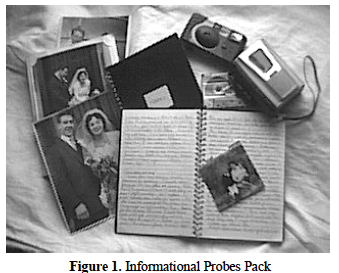 Source: (Crabtree et al., 2002)
Finnish academic Tuuli Mattelmäki (2006, p58) says that there are four powerful reasons for applying probes: INSPIRATION; INFORMATION; PARTICIPATION; and DIALOGUE.
 Source: (Mattelmäki, 2006)
All four of these reasons fit into my rationale for designing a probe for the initial recruitment phase of my research project. To be able to bracket my understanding of the phenomenon of aesthetics of use I have to be very careful how I prepare volunteers from the briefings. I cannot guide them in the use of an interactive installation, but I don't just want the volunteer to flounder in the face of unfamiliar technology.
 Source: (Mattelmäki, 2006)
 Source: (Mattelmäki, 2006)
 Source: (Mattelmäki, 2006)
 Source: (Mattelmäki, 2006)
I want to prepare them enough to understand it, but it is THEIR experience of the technology I am interested in. To ensure they appreciate what I am there for is not the same as them, I need to enter into a controlled (phenomenonologically bracketed) DIALOGUE with them so they have an awareness about 'experience'. Through the first part of MY PROBE they will be INSPIRED to PARTICIPATE through some reflective INFORMATION from them. My thoughts are for this stage is to use the postcard component of a Cultural Probe.

Source: (Júdice & Júdice, 2007)
This "Experience Pack" Probe Kit will be designed by myself and will be given out only to those who commit to volunteering at the briefings as homework before I meet them again for the first pre-observation contextual interview. The first task (more on this in a future post) will begin their awareness of what I am examining without me being didactic. At the contextual interview their responses can then be the focus of the discussion, through which I can prepare them for observation without influencing their potential actions on the day.
I will have a second post-observation task in the Probe they can do as an evaluatory and reflective exercise soon after their fun with the interactive installation. The results of this task will then be brought to the post-observation contextual interview. This means the design of only two components. As the abilities with technology are mixed within the potential volunteers I will include in the pack very concise directions for use, and maybe also a CD with oral directions too. This pack will be aesthetic too to facilitate engagement, and a souvenir of their time spent. Maybe also a certificate of involvement will be appealing to them? The Probe will fit in a tin meant to fit a plastic DVD box, and I'm thinking of applying a vinyl logo to the front of the case. This logo will be a numbered limited edition to add to the exclusiveness of those who volunteer out of those attending the briefing.
There are four stages to the Aesthetic Volunteers involvement: BRIEFING; INTERVIEW 1; OBSERVATION; and INTERVIEW 2. There are four reasons to apply a Probe (see above). The number FOUR seems to be a recurring number, so I will limit the Probe's contents to be FOUR items: TASK 1 (4 questions on 4 postcards); TASK 2 (TBA); 1 CD; and 1 CERTIFICATE.
But my "Experience Pack" isn't really a Cultural Probe as I'm more interested in finding out about experience from a phenomenological perspective. Does this make my pack a "Phenomena Probe"? Is it an "Empathy Probe"? Or is it a "Socio-cultural Probe"? I think I need to read Mattelmäki's PhD Dissertation to answer that.
References used:
BERNHAUPT, R., WEISS, A., OBRIST, M., and TSCHELIGI, M. (2007) Playful Probing: Making Probing More Fun. In Proceedings of the 11th IFIP TC 13 international Conference on Human-Computer interaction (Rio de Janeiro, Brazil). C. Baranauskas, P. Palanque, J. Abascal, and S. D. Barbosa, Eds. Lecture Notes In Computer Science. Springer-Verlag, Berlin, Heidelberg, 606-619.
CRABTREE, A., HEMMINGS, T., RODDEN, T., CHEVERST, K., CLARKE, K., DEWSBURY, G. AND ROUNCEFIELD, M. (2002) Probing for Information. In the proceedings of the 2nd EQUATOR Conference. November 2002. Brockenhurst. [Accessed 4 August 2010]. Available from World Wide Web: http://bscw.cs.ncl.ac.uk/pub/nj_bscw.cgi/S4ace2ee7/d50013/Crabtree,%20Hemmings,%20Rodden,%20Cheverst,%20Clarke,%20Dewsbury%20and%20Rouncefield-Probing%20for%20Information..pdf
DALSGAARD, T., SKOV, M.B., STOUGAARD, M. and THOMASSEN, B. (2006) Mediated Intimacy In Families: Understanding The Relation Between Children and Parents. In the proceedings of the 2006 Conference on Interaction Design and Children, June 07-09, 2006, Tampere, Finland. [Accessed 5 August 2010]. Available from World Wide Web: http://portal.acm.org/citation.cfm?id=1139110
JÚDICE, A. and JÚDICE, M. (2007) Designing Cultural Probes to Study “Invisible” Communities in Brazil. In the proceedings of Design Inquiries: The second Nordic Design Research Conference. Stockholm 27-30 May, Stockholm. [Accessed 5 August 2010]. Available from World Wide Web: http://www.nordes.org/data/uploads/papers/140.pdf
KJELDSKOV, J., GIBBS, M. R., VETERE, F., HOWARD, S., PEDELL, S., MECOLES, K. and BUNYAN, M. (2004) Using Cultural Probes to Explore Mediated Intimacy. In the proceedings of OzCHI, University of Wollongong, [Accessed 4 August 2010]. Available from World Wide Web: http://dl.acs.org.au/index.php/ajis/article/viewFile/128/107
MATTELMÄKI, T. (2006). Design Probes. Unpublished doctoral dissertation, University of Art and Design Helsinki. Helsinki, Finland.
 Source: (Kjeldskov et al., 2004)
 Source: (Dalsgaard et al., 2006)
 Source: (Crabtree et al., 2002)
Finnish academic Tuuli Mattelmäki (2006, p58) says that there are four powerful reasons for applying probes: INSPIRATION; INFORMATION; PARTICIPATION; and DIALOGUE.
 Source: (Mattelmäki, 2006)
All four of these reasons fit into my rationale for designing a probe for the initial recruitment phase of my research project. To be able to bracket my understanding of the phenomenon of aesthetics of use I have to be very careful how I prepare volunteers from the briefings. I cannot guide them in the use of an interactive installation, but I don't just want the volunteer to flounder in the face of unfamiliar technology.
 Source: (Mattelmäki, 2006)
 Source: (Mattelmäki, 2006)
 Source: (Mattelmäki, 2006)
 Source: (Mattelmäki, 2006)
I want to prepare them enough to understand it, but it is THEIR experience of the technology I am interested in. To ensure they appreciate what I am there for is not the same as them, I need to enter into a controlled (phenomenonologically bracketed) DIALOGUE with them so they have an awareness about 'experience'. Through the first part of MY PROBE they will be INSPIRED to PARTICIPATE through some reflective INFORMATION from them. My thoughts are for this stage is to use the postcard component of a Cultural Probe.

Source: (Júdice & Júdice, 2007)
This "Experience Pack" Probe Kit will be designed by myself and will be given out only to those who commit to volunteering at the briefings as homework before I meet them again for the first pre-observation contextual interview. The first task (more on this in a future post) will begin their awareness of what I am examining without me being didactic. At the contextual interview their responses can then be the focus of the discussion, through which I can prepare them for observation without influencing their potential actions on the day.
I will have a second post-observation task in the Probe they can do as an evaluatory and reflective exercise soon after their fun with the interactive installation. The results of this task will then be brought to the post-observation contextual interview. This means the design of only two components. As the abilities with technology are mixed within the potential volunteers I will include in the pack very concise directions for use, and maybe also a CD with oral directions too. This pack will be aesthetic too to facilitate engagement, and a souvenir of their time spent. Maybe also a certificate of involvement will be appealing to them? The Probe will fit in a tin meant to fit a plastic DVD box, and I'm thinking of applying a vinyl logo to the front of the case. This logo will be a numbered limited edition to add to the exclusiveness of those who volunteer out of those attending the briefing.

There are four stages to the Aesthetic Volunteers involvement: BRIEFING; INTERVIEW 1; OBSERVATION; and INTERVIEW 2. There are four reasons to apply a Probe (see above). The number FOUR seems to be a recurring number, so I will limit the Probe's contents to be FOUR items: TASK 1 (4 questions on 4 postcards); TASK 2 (TBA); 1 CD; and 1 CERTIFICATE.
But my "Experience Pack" isn't really a Cultural Probe as I'm more interested in finding out about experience from a phenomenological perspective. Does this make my pack a "Phenomena Probe"? Is it an "Empathy Probe"? Or is it a "Socio-cultural Probe"? I think I need to read Mattelmäki's PhD Dissertation to answer that.
References used:
BERNHAUPT, R., WEISS, A., OBRIST, M., and TSCHELIGI, M. (2007) Playful Probing: Making Probing More Fun. In Proceedings of the 11th IFIP TC 13 international Conference on Human-Computer interaction (Rio de Janeiro, Brazil). C. Baranauskas, P. Palanque, J. Abascal, and S. D. Barbosa, Eds. Lecture Notes In Computer Science. Springer-Verlag, Berlin, Heidelberg, 606-619.
CRABTREE, A., HEMMINGS, T., RODDEN, T., CHEVERST, K., CLARKE, K., DEWSBURY, G. AND ROUNCEFIELD, M. (2002) Probing for Information. In the proceedings of the 2nd EQUATOR Conference. November 2002. Brockenhurst. [Accessed 4 August 2010]. Available from World Wide Web: http://bscw.cs.ncl.ac.uk/pub/nj_bscw.cgi/S4ace2ee7/d50013/Crabtree,%20Hemmings,%20Rodden,%20Cheverst,%20Clarke,%20Dewsbury%20and%20Rouncefield-Probing%20for%20Information..pdf
DALSGAARD, T., SKOV, M.B., STOUGAARD, M. and THOMASSEN, B. (2006) Mediated Intimacy In Families: Understanding The Relation Between Children and Parents. In the proceedings of the 2006 Conference on Interaction Design and Children, June 07-09, 2006, Tampere, Finland. [Accessed 5 August 2010]. Available from World Wide Web: http://portal.acm.org/citation.cfm?id=1139110
JÚDICE, A. and JÚDICE, M. (2007) Designing Cultural Probes to Study “Invisible” Communities in Brazil. In the proceedings of Design Inquiries: The second Nordic Design Research Conference. Stockholm 27-30 May, Stockholm. [Accessed 5 August 2010]. Available from World Wide Web: http://www.nordes.org/data/uploads/papers/140.pdf
KJELDSKOV, J., GIBBS, M. R., VETERE, F., HOWARD, S., PEDELL, S., MECOLES, K. and BUNYAN, M. (2004) Using Cultural Probes to Explore Mediated Intimacy. In the proceedings of OzCHI, University of Wollongong, [Accessed 4 August 2010]. Available from World Wide Web: http://dl.acs.org.au/index.php/ajis/article/viewFile/128/107
MATTELMÄKI, T. (2006). Design Probes. Unpublished doctoral dissertation, University of Art and Design Helsinki. Helsinki, Finland.
Wednesday, 4 August 2010
Cultural Probes
In planning my research methodology based primarily on a phenomenonological research framework I am looking into the adaptation of Bill Gaver's "Cultural Probe" to begin the preparation of each research volunteer (more on this in future posts and via Aesthetic Volunteers).

Source: (Kjeldskov et al., 2004)
First developed by Gaver and his team in 1999, a Cultural Probe is a kit of inspirational materials designed and brought together to elicit responses from research volunteers. Hemmings suggests that "each probe object should be capable of invoking a different form of response that fits within a category of acceptable emotional responses" (Hemmings et al., 2002, pp44-45). With each object within the kit, it is there to provoke "inspirational responses from people" (Gaver et al., 2004, p53).
 Source: (Gaver et al., 2004)
These responses are in no way comprehensive information about the individual, they can be seen as "fragmentary clues about their lives and thoughts" (ibid). Gaver sees Probes as producing a dialectic between the researcher and volunteer (2004, p55). The Probe kit is not to be used in front of the researcher but like "planetary probes, cultural probes are ‘sent-out’ by researchers and return fragmentary data over time" (Kjeldskov et al., 2004, p4)
 Source: (Gaver et al., 2004)
The Cultural Probe can bring in valuable information in an non-scientific way, relying on more creative methods. Gaver is critical of those who have adapted the idea and have since made it more analytical. He warns that in making it too focused on specific analysable results, the researcher loses the rich insights into a subject's experience.
 Source -unpublished: (Gaver et al., 2004)
One of the researchers to have adapted Cultural Probes is Adam Crabtree from the Equator Group. Cultural Probes are in no way problem free. An inherent problem for a researcher is "just what the data is and, with that, just what the focus of analysis is" (Crabtree et al., 2003, p9). Like those design researchers who use Cultural Probes, Crabtree sees them being "the first stage in an ongoing and difficult process of design" (ibid) providing useful insights that can be explored through the design phase or through a more detailed qualitative study.
 Source: (Gaver et al., 2004)
My interest in using Cultural Probes is in developing the notion into a probe to begin the next research project. I will be using a volunteer group to engage in using an unfamiliar interactive installation within a gallery environment. This is to explore, from a Visual Communication perspective the Aesthetics of Interaction, observing an aesthetic experience of each volunteer. Before this activity I need to bracket my prior knowledge and experience to enter the research objectively. I will be selecting the volunteers from two briefing meetings in September. When each person volunteers they will be given a very specific 'EXPERIENCE' Probe. They will be asked to complete the tasks and bring the Probe with them at a contextual interview before the gallery event. This Probe will begin the process of understanding the volunteers prior thoughts on what 'experience' is, how they understand to recognise 'an experience', how the felt when within it, and their emotions whilst recollecting it.
 Source: (Gaver et al., 2004)
This needs more development (and another post). I have included below some visuals of existing Cultural Probes as examples. My idea will not include cameras or diaries, as during the event they will be videoed and photographed any way for my own reference.
References used:
GAVER, W., BOUCHER, A., PENNINGTON, S., and WALKER, B. (2004). Cultural Probes and the Value of Uncertainty. Interactions 11(5), 53-56.
CRABTREE, A., HEMMINGS, T., RODDEN, T., CHEVERST, K., CLARKE, K., DEWSBURY, G., HUGHES, J. and ROUNCEFIELD, M. (2003) Designing with Care: Adapting Cultural Probes to Inform Design in Sensitive Settings, in Proc. of International Conference of the Australian Computer-Human Interaction Special Interest Group (OzCHI’03), pp. 4-13
HEMMINGS, T., CLARKE, K., CRABTREE, A., RODDEN, T. AND ROUNCEFIELD, M. (2002) Probing the Probes, Proceedings of the 7th Biennial Participatory Design Conference, pp. 42-50, Malmö, Sweden: Computer Professionals for Social Responsibility. [Accessed 4 August 2010]. Available from World Wide Web: http://www.mrl.nott.ac.uk/~axc/documents/papers/PDC02.pdf
KJELDSKOV, J., GIBBS, M. R., VETERE, F., HOWARD, S., PEDELL, S., MECOLES, K. and BUNYAN, M. (2004) Using Cultural Probes to Explore Mediated Intimacy. Proceedings of OzCHI, University of Wollongong, [Accessed 4 August 2010]. Available from World Wide Web: http://dl.acs.org.au/index.php/ajis/article/viewFile/128/107

Source: (Kjeldskov et al., 2004)
First developed by Gaver and his team in 1999, a Cultural Probe is a kit of inspirational materials designed and brought together to elicit responses from research volunteers. Hemmings suggests that "each probe object should be capable of invoking a different form of response that fits within a category of acceptable emotional responses" (Hemmings et al., 2002, pp44-45). With each object within the kit, it is there to provoke "inspirational responses from people" (Gaver et al., 2004, p53).
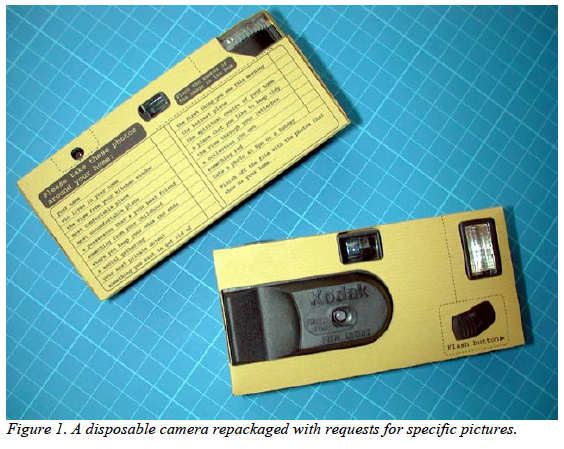 Source: (Gaver et al., 2004)
These responses are in no way comprehensive information about the individual, they can be seen as "fragmentary clues about their lives and thoughts" (ibid). Gaver sees Probes as producing a dialectic between the researcher and volunteer (2004, p55). The Probe kit is not to be used in front of the researcher but like "planetary probes, cultural probes are ‘sent-out’ by researchers and return fragmentary data over time" (Kjeldskov et al., 2004, p4)
 Source: (Gaver et al., 2004)
The Cultural Probe can bring in valuable information in an non-scientific way, relying on more creative methods. Gaver is critical of those who have adapted the idea and have since made it more analytical. He warns that in making it too focused on specific analysable results, the researcher loses the rich insights into a subject's experience.
 Source -unpublished: (Gaver et al., 2004)
One of the researchers to have adapted Cultural Probes is Adam Crabtree from the Equator Group. Cultural Probes are in no way problem free. An inherent problem for a researcher is "just what the data is and, with that, just what the focus of analysis is" (Crabtree et al., 2003, p9). Like those design researchers who use Cultural Probes, Crabtree sees them being "the first stage in an ongoing and difficult process of design" (ibid) providing useful insights that can be explored through the design phase or through a more detailed qualitative study.
 Source: (Gaver et al., 2004)
My interest in using Cultural Probes is in developing the notion into a probe to begin the next research project. I will be using a volunteer group to engage in using an unfamiliar interactive installation within a gallery environment. This is to explore, from a Visual Communication perspective the Aesthetics of Interaction, observing an aesthetic experience of each volunteer. Before this activity I need to bracket my prior knowledge and experience to enter the research objectively. I will be selecting the volunteers from two briefing meetings in September. When each person volunteers they will be given a very specific 'EXPERIENCE' Probe. They will be asked to complete the tasks and bring the Probe with them at a contextual interview before the gallery event. This Probe will begin the process of understanding the volunteers prior thoughts on what 'experience' is, how they understand to recognise 'an experience', how the felt when within it, and their emotions whilst recollecting it.
 Source: (Gaver et al., 2004)
This needs more development (and another post). I have included below some visuals of existing Cultural Probes as examples. My idea will not include cameras or diaries, as during the event they will be videoed and photographed any way for my own reference.
References used:
GAVER, W., BOUCHER, A., PENNINGTON, S., and WALKER, B. (2004). Cultural Probes and the Value of Uncertainty. Interactions 11(5), 53-56.
CRABTREE, A., HEMMINGS, T., RODDEN, T., CHEVERST, K., CLARKE, K., DEWSBURY, G., HUGHES, J. and ROUNCEFIELD, M. (2003) Designing with Care: Adapting Cultural Probes to Inform Design in Sensitive Settings, in Proc. of International Conference of the Australian Computer-Human Interaction Special Interest Group (OzCHI’03), pp. 4-13
HEMMINGS, T., CLARKE, K., CRABTREE, A., RODDEN, T. AND ROUNCEFIELD, M. (2002) Probing the Probes, Proceedings of the 7th Biennial Participatory Design Conference, pp. 42-50, Malmö, Sweden: Computer Professionals for Social Responsibility. [Accessed 4 August 2010]. Available from World Wide Web: http://www.mrl.nott.ac.uk/~axc/documents/papers/PDC02.pdf
KJELDSKOV, J., GIBBS, M. R., VETERE, F., HOWARD, S., PEDELL, S., MECOLES, K. and BUNYAN, M. (2004) Using Cultural Probes to Explore Mediated Intimacy. Proceedings of OzCHI, University of Wollongong, [Accessed 4 August 2010]. Available from World Wide Web: http://dl.acs.org.au/index.php/ajis/article/viewFile/128/107
Bibliography
It's been over a week since I officially posted last, but I've not been idle. Under the BIBLIOGRAPHY link above I have placed my working bibliography for my research so far. It is not complete by any means, but currently it has about 76 sources. Over the last week I have systematically been annotating each source. Some of these annotations have existed in disparate forms across several different blogs, and in Word documents. Some entries had no notes next to them at all, except those locked away in my head. Since the last blog entry I have instead been adding new annotations to the basic sources. I still have about 30 annotations to go before adding new annotated sources.
The exercise in annotating has been beneficial though. Some sources that I have referenced have on annotating, proven to be less influential than I had previously thought. Other sources in contrast have proved to be very influential, and I have struggled in writing concisely about these. I have also begun to spot blatant typographical errors (sorry to Bill Gaber >I mean< Gaver to name one obvious error). Also handwriting the sources back into Harvard from other referencing systems is becoming tiresome. So it now good that this page will act as a central repository of my official bibliography, from which shorter bibs can be compiled (in any format). Also before anyone comments why I don't use any of the official academic tools to compile my sources, I learn more by hand writing them into Harvard. Therefore my grumbles are simply academic.
The exercise in annotating has been beneficial though. Some sources that I have referenced have on annotating, proven to be less influential than I had previously thought. Other sources in contrast have proved to be very influential, and I have struggled in writing concisely about these. I have also begun to spot blatant typographical errors (sorry to Bill Gaber >I mean< Gaver to name one obvious error). Also handwriting the sources back into Harvard from other referencing systems is becoming tiresome. So it now good that this page will act as a central repository of my official bibliography, from which shorter bibs can be compiled (in any format). Also before anyone comments why I don't use any of the official academic tools to compile my sources, I learn more by hand writing them into Harvard. Therefore my grumbles are simply academic.
Monday, 26 July 2010
Textural-Structural Description of an Experience
I'm currently reading Phenomenal Research Methods by Clark Moustakas, a seminal work within Phenomenological qualitative research, to understand how to formulate my own Visual Communication research methodology. Husserl's Noema and Noesis becomes part of the methodology of understanding the meanings and essences of phenomena, through the construction of an Individual Textural Description and an Individual Structural Description.
The Individual Textural Description is constructed from transcripts of the interview going through a rigorous analysis to obtain relevant "validated invariant constituents and themes" (more in another post on that I think?).
The Individual Structural Description of the experience is based upon the textural description and "Imaginative Variation" (another post?).
The overall experience across the group can then be drawn from the descriptions into a Composite Description.
This is based on the Van Kaam method of analysis of Phenomenological data. Although the Stevick-Colaizzi-Keen method is in structure different, the use of the Textural-Structural Description appears to be the same. (pp120-122)
References used:
MOUSTAKAS, C. (1994) Phenomenological Research Methods. Sage Publications.
The Individual Textural Description is constructed from transcripts of the interview going through a rigorous analysis to obtain relevant "validated invariant constituents and themes" (more in another post on that I think?).
The Individual Structural Description of the experience is based upon the textural description and "Imaginative Variation" (another post?).
The overall experience across the group can then be drawn from the descriptions into a Composite Description.
This is based on the Van Kaam method of analysis of Phenomenological data. Although the Stevick-Colaizzi-Keen method is in structure different, the use of the Textural-Structural Description appears to be the same. (pp120-122)
References used:
MOUSTAKAS, C. (1994) Phenomenological Research Methods. Sage Publications.
Saturday, 24 July 2010
Volunteer Recruitment
I've been on my MPhil/PhD at Edinburgh College of Art part-time since September 2008, but only moved permanently to Edinburgh in 2009. In order to expand my social circle in a new city (and country) I was eventually introduced to Meetup in January 2010. Meetup is a US real-time social networking website where people in different cities advertise local group meetings. The groups are a mix between professional networking opportunities and specific-interest groups. In February I joined a cinema group and comedy group amongst others, and quickly found myself becoming an assistant organiser for both; organising cinema and comedy club visits for each group.
Over the Spring I not only had opportunities to socialise and unwind from work (lecturing and research), but I also had the inkling of an opportunity that could benefit me. I was bitten by the Meetup concept and I had become an organiser of my own Meetup group - The Edinburgh High Brow/Low Brow Culture Group. By subscribing to Meetup as a full-blown organiser I found I could run 3 different groups under 1 subscription. In becoming an organiser I had the resource to contact hundreds of people in Edinburgh, with some free time on their hands, and who were actively looking for interesting activities. I would be needing people with free time, a curious nature, who would be willing to sign up to be observed engaged in an activity.
Aesthetic Volunteers was born.
The Meetup group would transparently be a call for volunteers to help in all of my proposed research projects as part of my MPhil/PhD. Through the website's tools I could use specific social networking to ask for help, capturing the interest and curiousity of a huge cross-section of people, who want to be part of something fun.
In the first two weeks of the group I have 26 members 13 of which have signed up for two briefing events 2 months away. These numbers won't translate directly into volunteers but I am amazed how quickly I have achieved such interest. It just shows that even when I am employing effort to avoid doing PhD work, I have inadvertently been doing the ground work for my PhD!
Over the Spring I not only had opportunities to socialise and unwind from work (lecturing and research), but I also had the inkling of an opportunity that could benefit me. I was bitten by the Meetup concept and I had become an organiser of my own Meetup group - The Edinburgh High Brow/Low Brow Culture Group. By subscribing to Meetup as a full-blown organiser I found I could run 3 different groups under 1 subscription. In becoming an organiser I had the resource to contact hundreds of people in Edinburgh, with some free time on their hands, and who were actively looking for interesting activities. I would be needing people with free time, a curious nature, who would be willing to sign up to be observed engaged in an activity.
Aesthetic Volunteers was born.
The Meetup group would transparently be a call for volunteers to help in all of my proposed research projects as part of my MPhil/PhD. Through the website's tools I could use specific social networking to ask for help, capturing the interest and curiousity of a huge cross-section of people, who want to be part of something fun.
In the first two weeks of the group I have 26 members 13 of which have signed up for two briefing events 2 months away. These numbers won't translate directly into volunteers but I am amazed how quickly I have achieved such interest. It just shows that even when I am employing effort to avoid doing PhD work, I have inadvertently been doing the ground work for my PhD!
My Interaction Design Research Triangle
 Figure 1: The model of interaction design research that my research takes
Using Fallman's model I see my research into the Aesthetics of Interaction from a Visual Communication perspective taking the following dimension, loop and trajectory:
DIMENSION - My research is phenomenologically qualitative and emerges from theory, through exploration into practice. Therefore the situating of my research within Fallman's framework fits between the labels Design Exploration and Design Practice.
TRAJECTORY - I see my research's trajectory as being from Design Exploration towards Design Practice.
LOOP - To gain the desired trajectory path, the beginning obviously begins with a gap in Design Practice. The loop then takes a theoretical turn (it is a PhD after all) through the Design Studies triangle, before entering the Design Exploration onto the trajectory path.
Friday, 23 July 2010
The Umea Interaction Design Research Triangle
The Interaction Design Research Triangle of Design Practice, Design Studies, and Design Exploration - Daniel Fallman
 Figure 1: The model of interaction design research in its most basic form
 Figure 2: The model of interaction design research - trajectories, loops and dimensions
 Figure 3: A more complete model of interaction design research
References used:
FALLMAN, D. (2008) The Interaction Design Research Triangle of Design Practice, Design Studies, and Design Exploration. Design Issues. 24(3), 4-18.
Instrumentality of Aesthetics
 CREATE 10 SLIDE: Instrumentality of Aesthetics
Image Source: © sebastian tiplea http://creattica.com/photos/case-logic/27495
Noema and Noesis - intentionality
In Aristotelian philosophy intention indicates "the orientation of the mind to its object; the object exists in the mind in an intentional way" (p28). Phenomenologist Moustakas references J.J. Kockelman's summary of Aristotle, and in doing so sets the ground from which he can explain E. Husserl's concept of noema and noesis to describe the "interpretive form" within perception.
Noema = is the phenomena and not the 'real' object (textual)
Noesis = the initial underlying meaning (structural)
The noema-noesis relationship is a working out of the function of intentionality within an experience. The textual and structural dimensions of the phenomenon experienced is to uncover its meaning, moving from initial anonymity of its intentionality towards a conscious understanding.
The noema is what Husserl describes as "perceived as thus", and
the noesis is the "perfect self-evidence".
For every noema there is a noesis and vice versa.
Noematic meanings continually perceptively change depending upon point of view and situation, its meaning a synthesis from continual many-angled perception of "objects (real or imaginery) that are before us in consciousness" (p31).
The noesis comes from "explicating how beliefs about such objects may be acquired". The structural noesis leads us to understand how we experience the phenomena. Once understood this leads to a correlation of "intentionality into meanings and essences of experience" (p32)
References used:
MOUSTAKAS, C. (1994) Phenomenological Research Methods. Sage Publications.
Noema = is the phenomena and not the 'real' object (textual)
Noesis = the initial underlying meaning (structural)
The noema-noesis relationship is a working out of the function of intentionality within an experience. The textual and structural dimensions of the phenomenon experienced is to uncover its meaning, moving from initial anonymity of its intentionality towards a conscious understanding.
The noema is what Husserl describes as "perceived as thus", and
the noesis is the "perfect self-evidence".
For every noema there is a noesis and vice versa.
Noematic meanings continually perceptively change depending upon point of view and situation, its meaning a synthesis from continual many-angled perception of "objects (real or imaginery) that are before us in consciousness" (p31).
The noesis comes from "explicating how beliefs about such objects may be acquired". The structural noesis leads us to understand how we experience the phenomena. Once understood this leads to a correlation of "intentionality into meanings and essences of experience" (p32)
References used:
MOUSTAKAS, C. (1994) Phenomenological Research Methods. Sage Publications.
An Experience of an Experience
When we experience something (a phenomenon) our self-perception that this is familiar or new is typical. If familiar this is because we have experienced similar processual units of activity in the past, from which we try to make sense of the current phenomena. If it is new then that means our recognition of the phenomena is not causing a replaying of previous experiences from which we can understand what to do now. These processual units of past experiences can be articulated from our own prior experiences, or from the experiences of others expressed to us through narratives. We are not only having an experience of an experience but also performing a new meaning based on re-construction.
References used:
BRUNER, E.M. (1986) Experience and Its Expressions. In: V.W. TURNER & E.M. BRUNER, ed(s). The Anthropology of Experience. Chicago: University of Illinois, pp3-30.
ABRAHAMS, R.D. (1986) Ordinary and Extraordinary Experience. In: V.W. TURNER & E.M. BRUNER, ed(s). The Anthropology of Experience. Chicago: University of Illinois, pp45-72.
References used:
BRUNER, E.M. (1986) Experience and Its Expressions. In: V.W. TURNER & E.M. BRUNER, ed(s). The Anthropology of Experience. Chicago: University of Illinois, pp3-30.
ABRAHAMS, R.D. (1986) Ordinary and Extraordinary Experience. In: V.W. TURNER & E.M. BRUNER, ed(s). The Anthropology of Experience. Chicago: University of Illinois, pp45-72.
Thursday, 22 July 2010
I::MY::YOU
I Experience MY Experience of YOU
We can empathise but we cannot experience directly what another experiences. It is our own. We can reflect on our experience and make it 'storyable' to communicate the essence to another. Within that recounted narrative on another person's experience, I experience through my embodied situation observing and listening to that person, what I experience. I make that person's experience MY own, but it is constructed based upon MY past experiences of similar processual actions and emotions. This construction is a socio-cultural construction, and happens within a familiar and shared socio-cultural context.
References used:
KAPFERRER, B. (1986) Performance and the Structuring of Meaning and Experience. In: V.W. TURNER & E.M. BRUNER, ed(s). The Anthropology of Experience. Chicago: University of Illinois, pp188-203.
We can empathise but we cannot experience directly what another experiences. It is our own. We can reflect on our experience and make it 'storyable' to communicate the essence to another. Within that recounted narrative on another person's experience, I experience through my embodied situation observing and listening to that person, what I experience. I make that person's experience MY own, but it is constructed based upon MY past experiences of similar processual actions and emotions. This construction is a socio-cultural construction, and happens within a familiar and shared socio-cultural context.
References used:
KAPFERRER, B. (1986) Performance and the Structuring of Meaning and Experience. In: V.W. TURNER & E.M. BRUNER, ed(s). The Anthropology of Experience. Chicago: University of Illinois, pp188-203.
An Aesthetic Experience
 CREATE 10 SLIDE: Moving Across the Boundaries
Image Source: © iMarc http://creattica.com/posters/discovery/25486
The Phenomenological Quotidian
I first read of the term "Phenomenological Quotidian" in an essay by R.D. ABRAHAMS. In his essay Ordinary and Extraordinary Experience he draws pragmatist philosophy to phenomenology with an indirect comparison between the "Quotidian" and the pragmatist's concept of "experiential flow" (p68). Abrahams discusses a balance that on "the one hand, there is a flow of activity [pragmatist], and on the other, distinctive marked-out acts and events [quotidean], all going under the name of experience." His reasoning is based upon sociological phenemonologist Alfred Schutz's "contrast between ‘the world of paramount reality’ and all others". The quotidian being a "a representation of the ‘real’ world from which all other states of experience depart" (p67).
I am still to come across this term in the phenomenological literature I have, but the pragmatist idea of "experiential flow" may have links to a book I still need to read (on my reading pile since March 2009) that I'm sure will be come very useful. The book is Flow: The Psychology of Optimal Experience by Mihaly Csikszentmihalyi.
References used:
ABRAHAMS, R.D. (1986) Ordinary and Extraordinary Experienc. In: V.W. TURNER & E.M. BRUNER, ed(s). The Anthropology of Experience. Chicago: University of Illinois, pp45-72.
I am still to come across this term in the phenomenological literature I have, but the pragmatist idea of "experiential flow" may have links to a book I still need to read (on my reading pile since March 2009) that I'm sure will be come very useful. The book is Flow: The Psychology of Optimal Experience by Mihaly Csikszentmihalyi.
References used:
ABRAHAMS, R.D. (1986) Ordinary and Extraordinary Experienc. In: V.W. TURNER & E.M. BRUNER, ed(s). The Anthropology of Experience. Chicago: University of Illinois, pp45-72.
Experience :: An Experience
What is the distinction between mere ‘experience’ and ‘an experience’?
Wilhelm Dilthey (a German historian, psychologist, sociologist and hermeneutic philosopher) made a distinction. He saw 'experience' as a temporal flow that is received by individual consciousness. 'An experience' has a beginning and an ending. It is an intersubjective articulation, transformed into an expression* of that experienceª.
* how individual experience is framed and articulated
ª how reality presents itself to consciousness
References used:
BRUNER, E.M. (1986) Experience and Its Expressions. In: V.W. TURNER & E.M. BRUNER, ed(s). The Anthropology of Experience. Chicago: University of Illinois, pp3-30.
Wilhelm Dilthey (a German historian, psychologist, sociologist and hermeneutic philosopher) made a distinction. He saw 'experience' as a temporal flow that is received by individual consciousness. 'An experience' has a beginning and an ending. It is an intersubjective articulation, transformed into an expression* of that experienceª.
* how individual experience is framed and articulated
ª how reality presents itself to consciousness
References used:
BRUNER, E.M. (1986) Experience and Its Expressions. In: V.W. TURNER & E.M. BRUNER, ed(s). The Anthropology of Experience. Chicago: University of Illinois, pp3-30.
Wednesday, 21 July 2010
Visual Communication and the Aesthetics of Use
 CREATE 10 SLIDE: Facilitating the Behavioural Change
Image Source: © DigitalRey http://creattica.com/skateboard/dynamix-skateboard-concepts/37645
Subscribe to:
Posts (Atom)